Friday, April 11, 2025

Margin Notes: Humpty Dumpty

Christina Elise Perry, Gabriel Rysdahl, Marie Dinolan,
and Kirk Gostkowski as Nicole, Troy, Spoon, and Max.
Photo by Matt Wells.

Seen on: Wednesday, 4/09/25.

Plot and Background
The Chain Theatre presents the New York premiere of Eric Bogosian's 2002 play about a vacation "off the grid" is thrown fully off the grid when there is a mass power outage, the range of duration of which is unknown.

What I Knew Beforehand
I have seen and reviewed a number of Chain productions over the years; and I knew some of Bogosian's work.

Thoughts:

Play: It's chilling how current a play from over twenty years ago feels, particularly one so fixated on the technology available at that time: Palm Pilots, cell phones with patchy signals (that were not yet smartphones), and wall-mounted landlines and fax machines. As the characters, in the wake of both Y2K and 9/11, get distracted by cell phone calls, crab about increased TSA guidelines, and idly discuss the chances of another plague wiping out millions, there's a certain grimness to the Greek Tragedy of it all. We in the audience know the distant future, even as we don't know the immediate future awaiting these characters. What caused this blackout? How long will it last? And, even more grimly for us city-dwellers watching, the keen awareness that while out in nature these characters have some access to fresh food, those in the city would be cut off from supplies much more immediately. We remember the short-supply panic of March 2020.

So all this feels both prescient and immediate, and brings back memories of that isolation and uncertainty. Director Ella Jane New crafts the dynamics of the group with agility, maintaining the lines of tension as the dangers, both outside and in, increase.

Monday, April 7, 2025

Weekly Margin 2025, W14: John Proctor is the Villain, Vanya, Iolanthe, The Threepenny Opera, Pirates! The Penzance Musical

What: A new play by Kimberly Belflower, about the high school English class of a small Georgia community in 2018, currently rocked by a recent #MeToo revelation about one of the student's parents, the return of another student after an unexplained six-month absence, and the reading of Arthur Miller's The Crucible.
And? Parts of it are perhaps a bit on the nose (the title does rather give the game away, considering the payoff for it doesn't hit until two-thirds in), but perhaps that's appropriate for a play set entirely in a high school classroom. It still packs a hell of a punch, helped largely by a rudely talented ensemble (able to authentically bring back what it was like to be a teen girl who just wanted to have her inside jokes with her friends), and an epic climactic sequence. It was a great modern read on what is a standard high school text (raise your hand if you were also in your high school's production of it?). Is it an overly simplified read of Proctor? Probably, but that's also a very teenage thing, that absolutism. In any case, the larger sentence should be "John Proctor is the villain in Abigail's story." My friend that I saw it with remarked as we were leaving that the people who needed to see this play probably wouldn't (she made a similar remark when we left Prayer for the French Republic, and she was right). But in this case, I replied, "I needed to see it." Today, now, this year, I needed to see it.

What is true that the primary audience will probably be there for Sadie Sink, star of Stranger Things. Good news, she's fantastic, as is the rest of the less-famous cast. 


4/03/25: Vanya
What: The Lucille Lortel hosts the New York transfer of the London hit, Simon Stephens' one-person adaptation of  the Chekhov classic, starring Andrew Scott.
And? I forget sometimes how terrible most of the sightlines are at the Lortel. Oh well. Andrew Scott is heartbreaking and funny and astonishing and wonderful, and the adaptation is interesting, but it is still Chekhov, who's not my favorite. Still glad I saw it, as Andrew Scott is always worth seeing live.

Andrew Scott. Photo by Marc Brenner.


Monday, March 31, 2025

Weekly Margin 2025, W13: Maybe Happy Ending, Love Life, Nye, The Half-God of Rainfall

3/25/25: Maybe Happy Ending
a repeat visit

3/27/25: Love Life
What: City Center Encores! presents the 1948 Kurt Weill/Alan Jay Lerner musical about an unhappy couple whose children cause them to look back on their relationship to see where it went wrong--with each time we visit them being a different point in America's history, even though the four family members do not age, spanning from 1791 to 1948, when the show itself premiered. Does that sound weird? It kind of is, but it's easy enough to follow in the moment.
And?  This is a classic example of how valuable the Encores! series is: a show that is not often revived (in this case, there isn't even a surviving cast album), presented with full orchestra and high-caliber talent, to give new voice to the score. And often with this sort of thing, we can see why that show isn't often revived. Though this production ran for a year, it's rather unfocused in its concept (though perhaps with a stronger director than we have here, that focus would be more precise: there's a clear framing lens of vaudeville acts around this archetypal nuclear family, though I missed the consistent flavor that would have made that clear enough that the Pippin-esque finale didn't feel so far out of left field.

The family themselves don't really become people I invest in, but I think this show must have hit very very differently in 1948. My dad writes about the mythologizing of America in musicals like Oklahoma!, The Music Man, and Guys and Dolls. He also writes about the marriage trope, wherein the central couple's union represents the cohesion of community as a whole. This musical is a prime candidate for both those lenses--a look back at America's history through the frame of this family, but even more so, the nation's precarious state of maintaining unity in the wake of the Second World War, which had ended only three years previously (I wonder now why there wasn't a chapter in the show that took place during the Civil War, but then we probably know the answer to that one). America was very divided over this war--whether to enter the fray or not (not even touching on how many supported Hitler's campaign), and then the devastating outcome of our use of nuclear force. Is this the sort of thing a nation can survive and still feel united? Though the musical itself doesn't address any wars (the closest it gets to commentary of any sort are Susan's campaign for the right to vote, and a scene set during the Prohibition Era), it is meant to present the couple with the same degree of uncertainty. Indeed, their final moment is the two of them carefully reaching across a tightrope to each other, trying to hold their balance and hopefully hold each other as well. It's not just the future of their family--it's the future of our nation's soul.

So I can see what's interesting about this show, conceptually (and it must have been something with its original Michael Kidd choreo!) without having particularly gotten a lot emotionally out of the Encores! staging. That being said, the music is lush (even if Alan Jay Lerner is outed here as recycling a lyric and song concept from this show later for Gigi), and my god, the voices. Brian Stokes Mitchell, always a powerful voice, infuses everything he does with such warmth and joy (even back in 2020 when he stood at his open window every night to sing "The Impossible Dream" to anyone walking by) that you can't help but love him. Kate Baldwin matches him for warmth and powerful vocals. And then the ensemble! Stunning voices and harmonies throughout, in a score that really does make a point to feature many of its players. John Edwards, as both the Hobo and the M.C., has an extraordinary baritone and it's a treat to hear him sing.

Kate Baldwin and Brian Stokes Mitchell as Susan Cooper and Sam Cooper,
with the ensemble. Photo by Joan Marcus.

Streaming Theater-Related Content I Watched

Monday, March 24, 2025

Weekly Margin 2025, W12: Operation Mincemeat, BOOP!, Fog and Filthy Air

What: The Broadway transfer of the West End hit, a tongue-in-cheek musical adaption of the real-life British mission of deception in World War II.
And? Y'all, this show is a goddamn delight. The five actors--three of whom also cowrote the piece--have perfected the timing of their physical comedy to help make this sharp, hilarious, and without falter. Jak Malone, who won an Olivier for this production, is a particular standout in his various roles, and manages to break everyone's heart with a six-minute song sung in total stillness--that's when you know the audience is hooked. Ben Stones, responsible for the set and costume design that help facilitate the countless quick character changes and space shifts, is a magician with his designs full of trap door surprises and delights that keep us gasping and laughing. This one's a real treat.

Claire Marie Hall, Zoe Roberts, David Cummings, and Natasha Hodgson.
Photo by Julieta Cervantes.


What: A new splashy musical about Betty Boop who, tired of her life in the spotlight, escapes to the real world to discover they love her just as much. Sort of Enchanted/Barbie vibes, but with Betty Boop.
And? This show knows who its audience is, and is catering to it like mad: tourists in town looking for a brightly colored, dance-filled, feel-good musical. I found myself questioning if I've missed the immense popularity of a cartoon I vaguely remember from childhood. More than that, though, I was often disappointed by what I felt were missed opportunities by the designers. When we're first introduced to Betty Boop's world, of cartoonish grey-scale, it's delightful and imaginative, and a balanced use of projections and practicals. But I desperately want more contrast once we journey to the real world. In those scenes, the use of projections feels lazy, like they just didn't feel like building real things. But the whole point that keeps getting hammered in is that this is real, everything here is real, so why can't the design reflect that? Form and content, baby! That being said, the costume design is pretty great (and has a beautiful reveal at the top of the second act), and the lighting design does wonders to balance the look and feel of the characters when we're seeing both worlds at once onstage: bathing the real world in warmth while washing out the cartoon world. Even the vocals were tailored to this contrast, as we heard the more legit singing of Betty's film colleagues contrasted with the hard-belt (and no vibrato) of her real-world love interest. I also think they could shave off a half hour on this show if they cut Faith Prince's character (I love her, but she's wasted here and not plot-essential). But the performers in general are great: good voices and good stylized delivery in particular from Jasmine Amy Rogers as Betty, and Stephen DeRosa as Grampy.


Stephen DeRosa, Jasmine Amy Rogers, and Phillip Huber as Grampy, Betty
Boop, and Pudgy. Photo by Matthew Murphy and Evan Zimmerman.


Thursday, March 20, 2025

Margin Notes: Fog and Filthy Air


Seen on: Thursday, 3/20/25.
Robert Homeyer as Father. Photo by Peter Welch.


Plot and Background
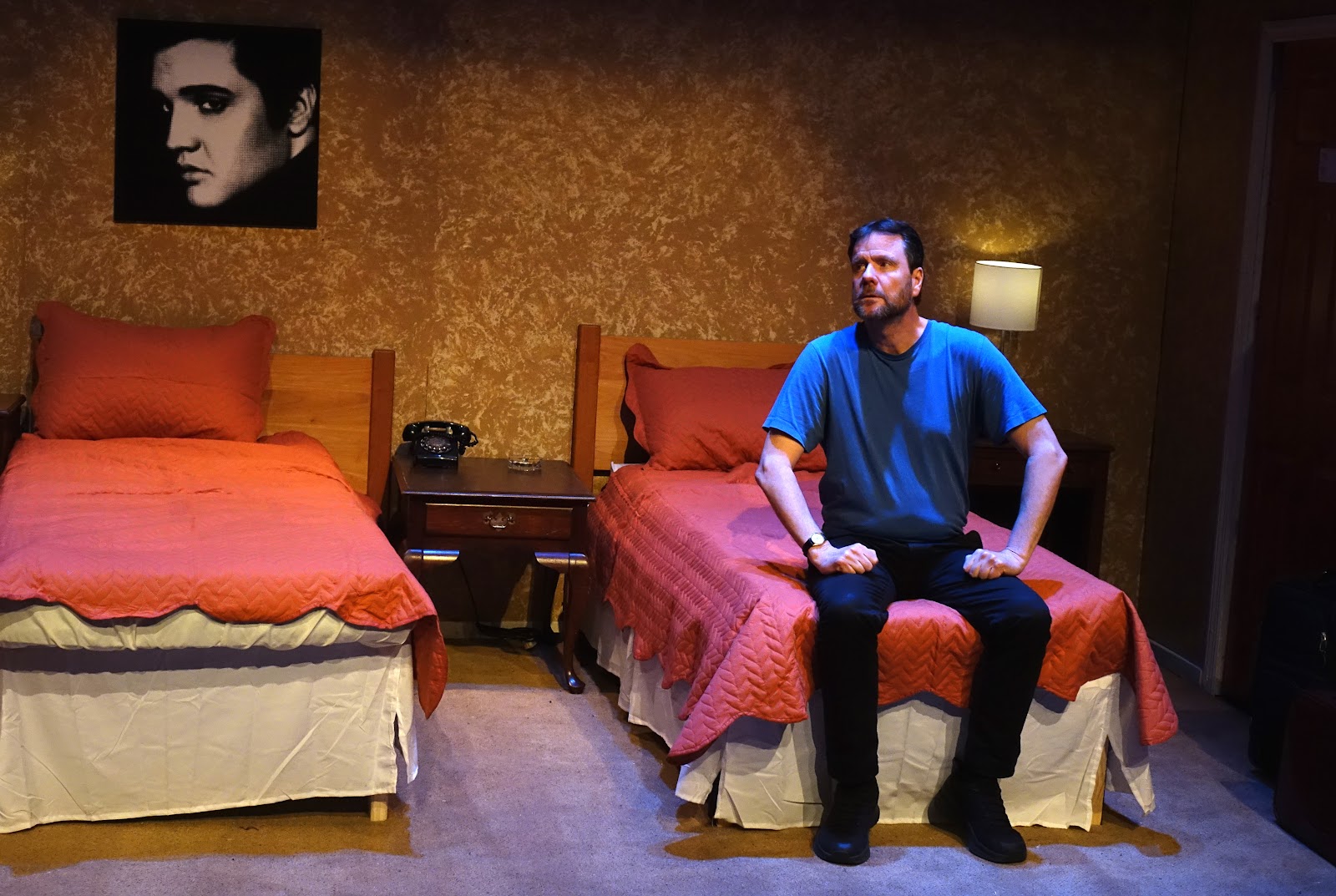
Theater For the New City presents Tom Diriwachter's new play, inspired by true events, about Tim, a playwright working as a waiter in a restaurant, who travels by bus to Memphis in the middle of the night to rescue his parents, staying in a purgatorial motel and unable to drive themselves home.

What I Knew Beforehand
That it was about a family in crisis.

Thoughts:

Play:
 It's hard, with plays based on real events, to decide how faithful you must stay to reality, and when you are allowed to take liberties. This play ultimately feels like its intent is an apology and a tribute to Tim's (playwright Tom Diriwachter's stand-in) parents, flawed as they are. In the play itself he is frustrated with them, frustrated with their inability to take his writing seriously or to communicate with him frankly. But when Tim himself is offstage the audience sees the deep love his parents have for each other, the way his mother protects her husband from the creeping frailty of his own faculties. The play then is Tom/Tim apologizing for not seeing that at the time, but recognizing it now, decades later. However, beyond that, I don't know what the play itself is actually about. Its focus drifts, as well as its conviction as to whether what we're even seeing is real or not. The poster image includes a line from the show invoking "the Devil's eyes" haunting the father as he drove; the characters repeatedly refer to the motel room as Hell (though to me it reads more as a purgatory, with a very Godot/Dumb Waiter energy of wondering if the characters can actually leave), and I wonder if the playwright hoped for the play to leave the literal into some bizarre otherspace where perhaps all three characters are dead and the story is about them accepting that truth. But maybe it really is just about a father having a nervous breakdown, and his wife and adult son gently helping him collect himself enough to go home.