 |
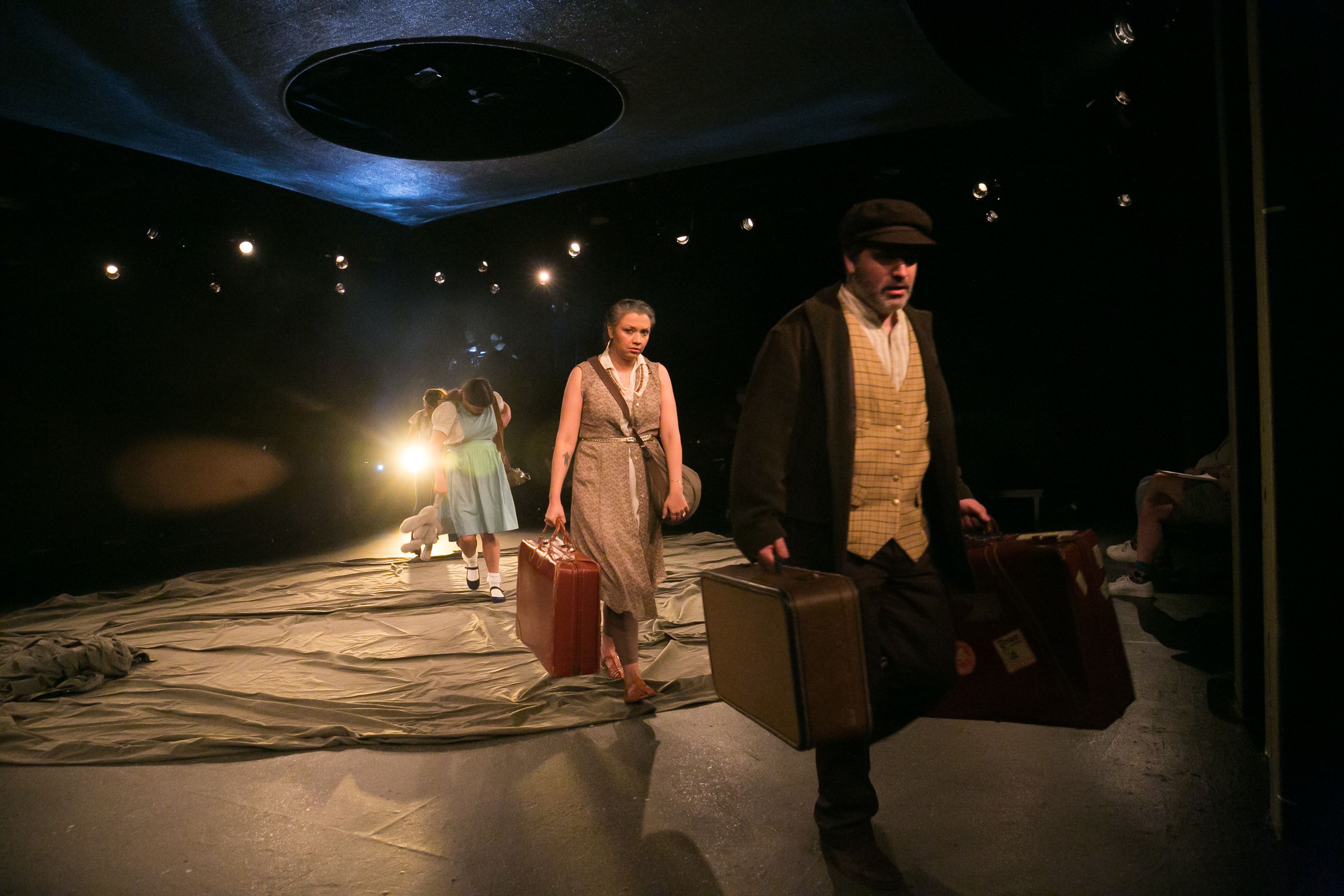
Masha King, Lina Silver, Cynthia Bastidas, and Jeff Rubino
as Annie, Molly, Edith, and Lot. Photo by Beowulf Sheehan. |
Thursday, 6/23/22.
My grade: B+Plot and Background
Voyage Theater Company presents the world premiere of Adam Kraar's adaptation of the Genesis story of Lot's wife, Edith, and their family's flight from Sodom's destruction. Voyage Theater is dedicated to presenting works of diverse cultures and disciplines.
What I Knew Beforehand
Vaguely I knew about Sodom, Gomorrah, and the pillar of salt.
Thoughts:
Play: As the audience enters the space, two gloved individuals dressed all in black are carefully tending to a vast, rumpled grey sheet spread across the playing space within the arena seating. They are not smoothing out the wrinkles but rather carefully defining them, crafting each ridge, each tiny mountain range of fabric. Occasionally they pause to look up at the night sky (as projected on the scrim overhead) or to gaze into an unseen horizon. The quiet care these two Shadows take with the space, coupled with the sound of Aviva Leong's Hebrew recitation, creates a meditative sense of a prepared space. When a shock of harsh side lighting blasts the space for the play's proper beginning, it transforms all to a desert plain, a lifeless arid wasteland that must be traversed by Edith, Lot, and their teen daughters Annie and Molly before the next sunrise. What follows is ninety minutes of a family trying not to fragment as they leave everything they know behind, all on Lot's faith that the two who warned him to leave were angels, and that this is their only chance to escape God's wrath upon the city of Sodom.
Playwright Adam Kraar has a facility with language, dropping evocative poetry like cool sips of water into the mouths of his characters: Lot, who says of his family, "in their faces, in their laughter, when they sleep, there is something holy"; Edith, who notices as they climb the mountain that "the stars up here don't twinkle"; Molly, who sees pomegranate seeds even in the bashed-through brains of an unnamed man; Annie, whose second sight tells of how he died, and of the deaths to come, warning that "something alive is burning." These lyrical moments are gifts that help lift the play out of some of its repetitive bickering, as Lot and Edith seem to have the same fight over and over without resolution. And then, perhaps that lack of resolution is the playwright's point. A story from the Hebrew Bible, like the Ancient Greek tragedies, is partially couched in the assumption that a majority of the audience knows how this story will end. At the last, Edith will look back. At the last, Edith will see the destruction (or, in some interpretations, including this one, she will see the Eye of God) and will turn to a pillar of salt. "I was bad, I know," Edith concludes, "but I was also good."
(small side note about the writing: this story is from the Hebrew Bible and yet sometimes the play's language has a more Christian understanding of worship than Jewish. This rankled me partly because I am tired of media discussion of "Old Testament" stories in a direct erasure of the Jewish religion. Lot and Edith are Jews. This is a Jewish story. Jews do not kneel upon the ground to pray.)