Wednesday, February 18, 2015

Margin Notes: Hamilton

Daveed Diggs, Okieriete Onaodowan, Anthony Ramos
and Lin-Manuel Miranda as Marquis de Lafayette, Hercules
Mulligan, John Laurens, and Alexander Hamilton.
Photo by Joan Marcus.
Hamilton

Seen on: Sunday, 2/1/15.
My grade: A++. This was spectacular, from start to finish. A truly extraordinary new musical.

Plot and Background
Lin-Manuel Miranda's biographical musical, inspired by Ron Chernow's book Alexander Hamilton, follows Hamilton from the rising of America's revolution, to Washington's presidency (with Hamilton as his right-hand man and Secretary of Treasury), through to Hamilton's death in a duel with Aaron Burr. Running parallel to the narrative is Hamilton's lifelong friendship/rivalry with Burr - the first an outspoken activist, the second a man more comfortable with the non-committal middle ground, but both vying for immortality and power. This is the show's world premiere and the run has already extended three times.

What I Knew Beforehand
I knew In the Heights quite well, as well as Miranda's other Broadway ventures - Bring it On and the Spanish translations in the revival of West Side Story. I knew some of Hamilton's story, due mostly to high school history class and that milk commercial. And I knew the production was going for racial diversity in a big way - as it happened, the only white cast members were either in the ensemble or Brian d'Arcy James as King George.

Thoughts:

Play: Miranda reunites with much of his In the Heights team, including director Thomas Kail and choreographer Andy Blankenbuehler, and brings back his signature mix of hip hop, rap, and love of old school musical theater to tell this story in a vivid, pulsing rhythm. It was truly thrilling to see just how much Miranda's skills have developed since ItH. I liked that show a lot, the score was incredible, but the story, such as it was, sort of meandered - it was about a community more than a narrative. Here in Hamilton, the story is crisp, clear, and with a distinct purpose in its telling. There's a driving rhythm, not just in the score, but in the characters themselves. There are moments of hilarity, like King George's light pop songs of cynical dismissal, or Jefferson's taunting of Hamilton's downfall after the Reynolds Pamphlet. And there are moments of absolute beauty and poignancy, such as the parallel Schuyler numbers of "Helpless" and "Satisfied" (that staging gave me feels, man), and Hamilton's climactic duel with Burr, as both their streams of consciousness are dilated out into a long desperate frozen moment in time. It was truly thrilling to watch this show unfold - it felt like we were all on the brink of something historic, something that could actually change musical theater and the way we tell stories, and whom we allow to tell them. It legitimized so many voices that have been traditionally marginalized, and there was nothing self-conscious or didactic about it. It was unapologetic, proud, and joyous - much like Hamilton himself (or at least as he's portrayed here). I can already tell this will make my top theatre list for the year.

Thursday, February 12, 2015

Margin Notes: Between Riverside and Crazy

Stephen McKinley Henderson as Pops.
Photo by Carol Rosegg.
Between Riverside and Crazy

Seen on: Friday, 1/23/15.
My grade: B -. Well enough done, but a rather inconclusive narrative for my style.

Plot and Background
Walter "Pops" Washington, a retired cop and widower, is living out his remaining days in a bit of a siege - refusing to settle on an 8-year-old suit against the city for some friendly fire that forced his retirement, ignoring threats of eviction, and providing shelter for his ex-con-current-small-time-criminal son, his son's shadier friend, and his potential daughter-in-law. Tensions rise as his old partner and her ambitious fiance try to leverage a settlement against his family's home and freedom, and question the truth behind his claims. Stephen Adly Guirgis's play had its New York premiere in 2014 at Atlantic Theater Company with a sold out run, and has now transferred to 2nd Stage.

What I Knew Beforehand
Pretty much nothing about the play itself. I knew it had transferred from a run last year at Atlantic Theater Company, and that it was Stephen McKinley Henderson's big break into leading role (he's been in every TV show and play ever, but often in sidekick or supporting roles). And I knew some of Stephen Adly Guirgis's other work - The Motherf*cker with the Hat, primarily, and The Last Days of Judas Iscariot.

Thoughts:

Play: While the play was definitely well-structured, with turns and reveals at every step that were both surprising and also somehow inevitable, I didn't find myself connecting particularly strongly to the story itself. Maybe it's that I kept feeling let down by characters I initially liked - no one quite living up to their potential, no one whom they professed initially to be. Manipulation is not an attractive trait to me. That being said, I didn't find myself bored or tuning out - I wanted to see how all this would fadge, even if I didn't necessarily emotionally invest in particular characters' outcomes. And it was worth it to see Stephen McKinley Henderson just exist onstage - a full, nuanced, vulnerable and abrasive performance.

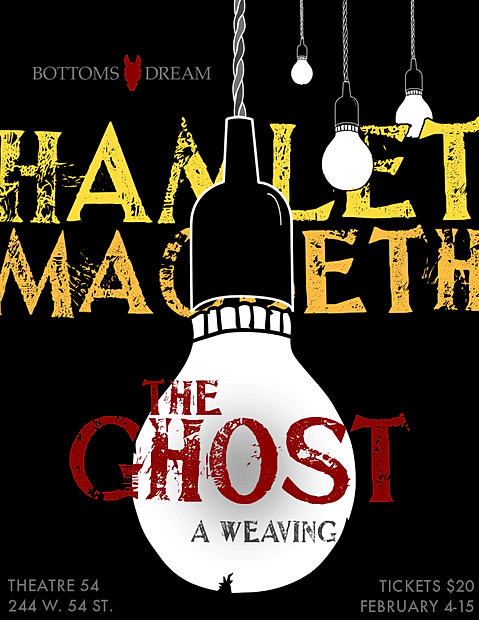
Margin Notes: The Ghost, a weaving


Seen on: Wednesday, 2/11/15.
My grade: B. Some really exciting ideas here.

Plot and Background
Bottoms Dream is an NY-based theatre company dedicated to reinventing classic texts. This production is the second in their Weaving series, following The Dream, which wove Romeo and Juliet and A Midsummer Night's Dream. This production weaves together Hamlet and Macbeth, utilizing the language and story of both plays to construct a new hybrid narrative, shading new colors onto certain characters. So here, Macbeth's struggle and narrative are laid on Claudius's shoulders, while Hamlet acquires the surname Macduff and all that that entails. Polonius and her offspring, meanwhile, carry the last name Banquo, and so provide a double threat to Claudius Macbeth. The plot, while shuffling around dialogue and subplots, is still largely faithful the core of both of its source plays - a soldier kills his king and brother to acquire throne and wife and, in his paranoia, begins knocking off anyone else he sees as a threat. Hamlet, meanwhile, is infirm of purpose but wants justice for his father's death.

What I Knew Beforehand
Mostly I knew that Bottoms Dream had begun exploring these Shakespearean interweavings, and that this - a weaving of Hamlet and Macbeth - is their second venture in that regard. Beyond that, I've studied both Ham and Mac (we're on nickname terms) numerous times, seen multiple productions of both, and have done scene work on both plays in the past.

Thoughts

Play: What a clever idea. Honestly, I wasn't quite sure what to expect - though I'd been warned not to exert too much energy focusing on where each line came from, and rather to pay attention to the story being told now, there was still some delight to be had in that game: to hear a familiar line, removed from context, turn into something entirely new (My two biggest - and most embarrassing - laughs were R&G's drunken toast, which turned out to be Polonius's brevity/mad speech, and the greeting of sisters Ophelia and Laertes - "Where have you been, sister?" // "Killing swine."). While the narrative in large part seemed to alternate which source play was taking dominance, the most compelling moments were often the moments of true weaving - such as the dual soliloquies of Claudius and Gertrude, taken from Macbeth, as they psyche themselves up for killing Duncan, Gertrude's husband; or the (noticing a pattern here?) dual soliloquies of these two again, at an empty banquet table, both consumed by guilt for what they have done, wondering, with the text from Hamlet, "May one be pardon'd and retain the offense?" The other fascinating element at play is how the new context for seemingly-familiar characters, sheds new - and often horrifying - light on them. Gertrude not only married her husband's killer, she helped in the killing; R&G, no longer incompetent lackeys, assist in scheming on both sides - performing in Hamlet's Mousetrap, but also serving as Macbeth's murderers to take out Polonius Banquo. In this narrative, no one's hands are clean (though Hamlet's are cleaner than usual) and no one, with the stink of death and tragedy coming from all directions, is safe.

Thursday, January 29, 2015

Margin Notes: Let the Right One In

Cristian Ortega and Rebecca Benson as Oskar and Eli.
Photo by Manuel Harlan.
Let the Right One In

Seen on: Saturday, 1/24/15.
My grade: A. Gorgeous production, faithful adaptation, fantastically acted, but a few missed opportunities in the staging.

Plot and Background
Oskar, a young teen perpetually bullied by his classmates and forced into self-sufficiency by an absent father and a distracted mother, meets his new neighbor Eli on the neighborhood jungle gym. Eli is alternately standoffish and friendly, but seems compelled by Oskar. Meanwhile, an old man is going around town killing people and draining their blood, for some unknown purpose. This dark but sweet story was adapted by Jack Thorne from both the Swedish novel and film by John Ajvide Lindqvist, and was previously performed by the National Theatre of Scotland at Dundee Rep and Royal Court in 2013, and on London's West End in 2014. St. Ann's Warehouse is now hosting it, and its run has already extended into March.

What I Knew Beforehand
I'd seen the Swedish film as well as the American remake, though I've not read the book. And I knew the company who created the production was Scottish, so I was looking forward to a Scottish Sweden, because I'm mature like that.

Thoughts

Play: It's rather hard to talk about the show without delving into spoilers, so ... guess what? Spoilers! Eli's a vampire. Or close enough. A young (and yet old), rather emotionally stunted vampire. And her relationship with Oskar, as in the film, grows organically - strange and awkward, but somehow sweet and deeply felt. The story is dark, with as much moral grey area as there is snow, and yet the innocence of their love keeps a clean feeling, even as we see Eli kill, repeatedly. There's a simple magic to their interactions. from her sudden appearance on the jungle gym, to her solving of Oskar's Rubix cube. While there are a few missed opportunities in staging (I'm thinking specifically of the climactic pool scene, where they went to the effort of creating a pool and then not quite using it during the confrontation), for the most part director John Tiffany and Associate Director/Movement coach Steven Hoggett find gorgeous stage pictures, horrifying displays of blood, and a marvelous economy of storytelling. If you loved the Swedish film (or even the American one), I doubt you'll be disappointed by this rendering. You may even love the story more.

Thursday, January 22, 2015

Margin Notes: Into the Woods

Andy Grotelueschen, Emily Young, Ben Steinfeld, Jennifer
Mudge, Claire Karpen, Patrick Mulryan, and Noah Brody.
Photo by Joan Marcus.
Into the Woods

Seen on: Wednesday, 1/7/15.
Ticket purchased: Alas, full price was all I could find.
My grade: B-. A solid enough idea of a production undermined by some of its elements.

Plot and Background
The familiar fairy tales of Cinderella, Jack and the Beanstalk, Little Red Riding Hood, and Rapunzel are interwoven with a new tale of a childless Baker and his Wife attempting to undo a curse. The first act takes us through their various interwoven stories as they all journey into the woods to seek their goals, and ends on a happily ever after; the second act shows us what happens after the ever after. This musical, by James Lapine and Stephen Sondheim, originally opened on Broadway in 1987. That production was immortalized in a televised broadcast of the original cast. It has been revived regionally and in New York a number of times since, and a film adaptation starring Meryl Streep is now playing in theaters. This production, though hosted by Roundabout, was created by Fiasco Theater, and features only ten actors.

What I Knew Beforehand
I know the show practically by heart, thanks to the DVD of the OBC (I've also seen multiple productions regionally and the movie adaptation). I loved Fiasco's production of Cymbeline in 2011 and 2012, which had only six actors and was an utter delight, and was very much looking forward to their next offering. I knew there would be some changes afoot here to accommodate the ten person cast, but I went in with high hopes.

Thoughts

Play: I have a great affection for Fiasco's joyful - and slightly chaotic - storytelling style. There's very much a sense of creation out of found objects, which gives a spontaneity to even the most carefully crafted moments. The Stepsisters' dresses can be two curtains on a rod; Rapunzel's tower can be a ladder; Milky White can be a man with a cowbell around his neck, squeezing an empty baby bottle (this last actually worked quite well, thanks to Andy Grotelueschen's sympathetic and funny performance). I've always thought that some of the most interesting staging and theatricality can come from having to solve problems with limited resources, and Fiasco is a fantastic illustration of that. There's something rather charming about the cast climbing onto the rolling piano as they sing the title song, and even something thrilling about the shadow play staging of the Giant's final attack at the end of the show (this may have actually been my favorite portrayal of the Giant I've seen). And with so much double-casting, quick onstage changes happen continually, and with some delightful results (I don't want to spoil the best ones except to say Florinda's transition to Milky White had me gasping with laughter, and the transition after "Witch's Lament" was haunting and lovely). The choreography within the songs itself was not always particularly dynamic or interesting, but staging of the show as a whole was exactly the kind of high-spirited controlled chaos I've come to expect from Noah Brody and Ben Steinfeld.