Monday, December 20, 2021

Weekly Margin 2021, W51: Striking 12, A Charlie Brown Christmas, Hindle Wakes, A Christmas Carol

12/18/21: Striking 12
What: Chance Theater's holiday show, a concert retelling of "The Little Match Girl," from the writing team of Brendan Milburn and Valerie Vigoda (Ernest Shackleton Loves Me) and Rachel Sheinkin (...Spelling Bee).
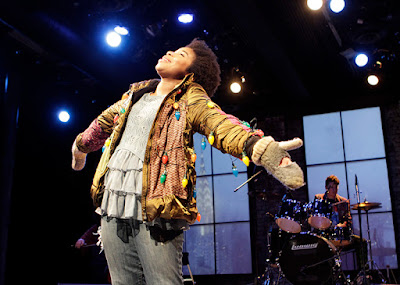
And? A charming little chamber musical, with the five cast members also serving as musicians (special props to Laura Leo Kelly and their drum solo, Lex Leigh sounding amazing on the electric violin, and Jacklyn Uweh on handheld percussives and bubbling over with charisma as the S.A.D. Light Seller/Little Match Girl), and it was fun to see an early work from writers I admire.

Jacklyn Uweh as S.A.D. Light Seller, with Laura Leo Kelly on drums.
Photo source.


What: Chance Theater's encore presentation of a family holiday show, a staging of exactly what it sounds like.
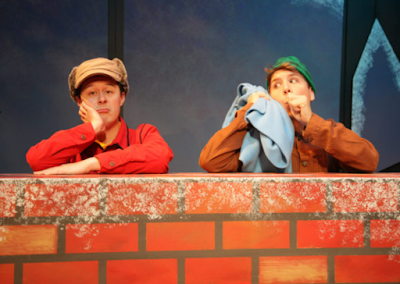
And? While the performances were deliberately very stylized (to appeal to the many many children in the audience and to harken to the television special), they were consistently so across the cast (yes, it grated a bit but it's also less than an hour). And I'll tell you what, I found the production design (Masako Tobaru and Megan Hill) and the staging (James Michael McHale) in this tiny theater a complete delight. Tiny houses and snow-laden trees appeared and disappeared on the snowy backdrop hills, manipulated by the actors using pulley systems. Two winter panels hinged from the walls to become the red velvet curtains for the rehearsal scene. Travel scenes were achieved by performers carrying houses and trees past the walking characters (yes, it's an old trick, but that doesn't make it any less charming). And, of course, Charlie Brown's sad and broken twig of a tree with its lone ornament was transformed by the children into a bedecked and lovely Christmas tree just in time for some singalong carols. 

Matt Takahashi and Juston Gonzalez-Rodholm as Charlie Brown and Linus.
Photo by Doug Catiller, True Image Studio.


Streaming Theater Related Content I Watched

Tuesday, December 14, 2021

Onstage and Streaming: My Top Theater for 2021


The first three quarters of 2021 was still the era of Streaming Theater Only, but as Autumn loomed, as more people got vaccinated, theaters began to reopen and we were finally able to return. Now, at the end of 2021, most of the theater I'm seeing is in person, though I'm grateful for the companies who continue to make their work accessible online (particularly the companies not local to me, like APT, Wilma Theater, Original Theatre, Wise Children, and East West Players). I'm hopeful that the future will continue to bring accessible theater to the world, not limiting the audience to only those immediately there or those who can afford the steep ticket prices asked by Broadway, West End, and the major touring houses.
Stephen Sondheim. Photo by Fred R. Conrad.

This year, like last, was hard. It was exhausting. It was, as of November 26th, once more devastatingly heartbreaking, when the giant Stephen Sondheim passed away. As more variants appear and we still haven't reached majority vaccination in our population, we still don't know what the future will hold for in-person gatherings. But y'all know by now I'm a silver lining person, so I can but hope. Amidst our grief and fear, we can hope, we can love, and we can appreciate the good, good art we were lucky enough to experience. This year I am pleased to have two Best Of lists--one for the streaming works that remain vivid for me now, and for the live theater I got attend this last quarter.

Oh and because I know I'm supposed to provide my annual tally, here you go: 103 streaming productions, 25 live plays (+2 repeat), 13 live musicals (+1 repeat), totaling 141 distinct productions (3 repeats).

Love, peace, and health to you all.

Monday, December 13, 2021

Weekly Margin 2021, W50: Cullud Wattah, Freestyle Love Supreme, Sympathetic Magic, The Gift of the Magi, Kristina Wong, Sweatshop Overlord

12/07/21: Cullud Wattah
What: The Public Theater presents a new play by Erika Dickerson-Despenza about the Cooper family: three generations of Black women in the second year of Flint, Michigan's still-ongoing water crisis.
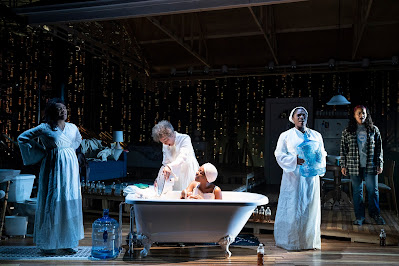
And? In 1985 (and again in 2004) The Public presented Larry Kramer's The Normal Heart, about the very early days of the AIDS crisis (taking place before it was even called AIDS) in New York. In both productions the walls of the theater were covered in statistics about the crisis, highlighting the ways in which both the media and the government were complicit in ignoring and even exacerbating the crisis. Now in 2021, Adam Rigg's scenic design for Cullud Wattah, a play tracking the early days of Flint's water crisis, that tradition continues: the walls of the Martinson are covered in tally marks, counting the days Flint, Michigan has been without clean water. And hanging from the rafters surrounding the performance space, as well as lining the floors of the Cooper house, are bottle after bottle filled with toxic brown water. This evidence, equally as damning of systemic complicity, frames Dickerson-Despenza's extraordinary play, just as the opening invocation of the spiritual "Wade in the Water"--here rewritten to be "Lead in the water, Snyder's playing God with the water"--reminds us of Black people's troubled history with water and how this crisis is one more act of violence from this country against them, as Black communities have been the ones most affected by this travesty. The play also shows clear ancestral roots in Lorraine Hansberry's A Raisin in the Sun, about the Younger family, their ambitions, and the pride of owning their own property. In this play, the Cooper's family home has lost nearly all its value due to the crisis, and its characters must reckon with their own deferred dreams: Big Ma's lost love, a love she was not safe to pursue in her youth; Ainee, a year sober from her personal poisons but now subject to Flint's toxins, finally carrying a viable pregnancy after six miscarriages; Marion, offered a promotion that could give her family the financial stability they so desperately lack, from GM, the very company that has been complicit in the tainted water supply; and Marion's children Plum and Reesee, trying to balance their hope for a future of clean water and choices, against the despair of the permanent damage the crisis has already inflicted on their bodies--Reesee with her blistering skin and Plum with her leukemia. This play is infuriating. This play is devastating. This play is filled to the brim with love. This play is so many things to be reckoned with.

Andrea Patterson, Lizan Mitchell, Alicia Pilgrim, Lauren F. Walker, and
Crystal Dickinson as Ainee, Big Ma, Plum, Reesee, and Marion.
Photo by Joan Marcus.

What: The Broadway engagement of the hip hop improv group founded by Lin-Manuel Miranda, Christopher Jackson, Thomas Kail, Arthur Lewis, Bill Sherman, Chris Sullivan, and Anthony Veneziale.
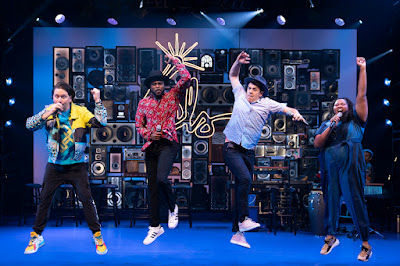
And? Both Sullivan and conceiver fVeneziale are still a part of of FSL's Broadway run (under the performer names Shockwave and Two Touch) and truly excellent, along with Tarik Davis (aka Tardis Hardaway) and musicians Kurt Crowley (aka The Lord and Lady Crowley) and Victoria Theodore, making her Broadway debut. Each performance also has an unannounced guest on microphone three, and the one for my performance was the delightful and powerful Tony winner, James Monroe Iglehart (aka J-Soul). This was a fun night, featuring a second chance at an unfortunate mushroom encounter, a love song to latkes and inner strength, and a musical day in the life of running a teacher training.

(Note: not the performers I saw) Chris Sullivan, Wayne Brady, Anthony
Veneziale, and Aneesa Folds. Photo by Joan Marcus.


Monday, December 6, 2021

Weekly Margin 2021, W49: Kimberly Akimbo, A Christmas Carol, The System

12/02/21: Kimberly Akimbo
What: Atlantic Theater presents a new musical adaptation of David Lindsay-Abaire's play of the same name (adapted by Lindsay-Abaire and Jeanine Tesori), about a teenage girl with a disease that causes her to age rapidly, making her appear in her seventies.
And? I loved this so much. So very very much. I need to read the play it's based on, to see how much it's changed in the rewrite. I need a cast album to be recorded. I need this to have a longer run. I have a lot of needs, y'all. This show could have been cloying, it could have been bitter, it could have been a manipulative tearfest. It is none of those things. It is cute without being twee, sweet without being sentimental, funny without being dishonest, and moving without being demoralizing. Looking at the cast list for the play, I see that the musical cast has expanded to include four of Kimberly's classmates (who, as members of showchoir, are a very willing and delightfully able backup group for songs). DLA's characters are all a bit off-center, in a delightful (and appropriately frustrating) way. Kimberly's parents are disappointments and often say the wrong thing, but at the core there is still love. Even her opportunist aunt (my god, can we just have Bonnie Milligan in everything? Her comic timing and her belt are a gift we need more of) has affection beneath her scheming. And Kimberly's growing friendship with Seth feels honest and earned. We watch the show knowing Kimberly's life has a ticking clock and that it will soon run out, but somehow the show doesn't leave us in despair, but rather in hope that we too can pursue happiness with the time we have. Oh and somehow I skipped over this but the entire cast is TO DIE FOR good, and especially especially Victoria Clark as Kimberly, whom you never doubt is a teenager, who breaks and wins your heart, whom you just want to be happy. Dear Theater Gods, a commercial transfer and a cast album, pretty pretty please and thank you?

Victoria Clark as Kimberly. Photo by Ahron R. Foster.


What: Merchant House's annual one man reading of Dickens's classic story, performed by John Kevin Jones.
And? Some may recall that I saw four or five online productions of A Christmas Carol last December. This was my favorite of the lot, so I was so excited to get to see it live this year. It's truly a special experience. You arrive at the Merchant's House Museum and walk through to the back garden for a cup of mulled wine or hot cider. Jones greets you, recites a poem, then leads you back inside to the parlor for his reading of A Christmas Carol. Up close you can see not only his joy but also his absolute and present empathy for every character he portrays. Worth every moment in that (unfortunately) extremely uncomfortable chair.

John Kevin Jones in A Christmas Carol. Photo source.


Streaming Theater Related Content I Watched

Monday, November 29, 2021

Weekly Margin 2021, W48: The Lehman Trilogy, Company, Woman in Black, Trouble in Mind, Flying Over Sunset, Morning's at Seven, Dana H

What: The Broadway transfer of the West End hit, about the rise and fall of the Lehman Brothers, the family and the company.
And? Nearly a repeat visit, since I saw this identical production on the West End, though with Ben Miles in the role of Emanuel Lehman, now played by Adrian Lester. The production remains extraordinary and riveting, and Lester is superb.

Adam Godley, Simon Russell Beale, and Adrian Lester.
Photo by Julieta Cervantes.


11/23/21: Company
What: The Broadway transfer of the West End gender-bent Furth-Sondheim musical about the perpetually single Bobbie and her many married friends.
And? [This was drafted before the passing of Stephen Sondheim. My opinion still stands, but I don't want you thinking I'm being callous about him or his work.] I dunno, maybe it's my fault. I went in with these expectations that the rewrite of the show, making Bobbie a woman (and making one of the couples two men about to get married) would revolutionize the narrative. Instead I feel like they backed themselves into a few ill-advised corners. The comparatively minor--but still worth noting?--shift of changing Bobbie's gender as well as  Bobbie's three romantic options and the Amy-to-Jamie conversion, means that the gender balance of the cast has tilted to male-heavy, even with its female center (what was a 6m:8f ratio is now 9m:5f). Meanwhile, though it may be nice to have a queer couple in the mix, the production has backed away quickly from nearly any hint of Bobbie's queerness (a small dialog-less flirt during "Another Hundred People" aside), with the sometimes-included terrace overture eliminated and the potential of having one of Bobbie's three lovers be a woman unexplored (at least, I thought it would be a nice thought). I know the writers have been historically resistant to inferences that Bobby is gay and that's why he can't commit to a woman, but if this new revisal is acknowledging queer commitment, then that argument is now invalid. And then choosing to make Jamie and Paul the gay couple means that Bobbie's mid-show proposition makes next to no sense. It needs to be absurd because she's asking someone who loves someone else, not because she's asking a gay man to marry her.

More than that, though, this portrayal of Bobbie sets itself up for failure from the start. Male Bobby is positioned as a problem to be solved--someone incomplete, deliberately removed from living his life, with the genuine wish for real partnership and connection his end-of-play evolution. A female Bobbie with that same lack and arc butts up against more contemporary dialog about how women don't need a relationship to complete them. And indeed, Katrina Lenk's Bobbie doesn't seem to be lacking anything. She's not a problem to be solved. The scenic design is more obsessed with her turning 35 than she is (there are 35 markers everywhere you look--address plaques, wall art, even the clocks are set to 3:05). Meanwhile, they've inserted transitional moments when she hears a baby crying in a void and keeps trying different glittery keys to unlock her next option. Is this a nod to 35 being the marker for a "geriatric pregnancy?" Is it about her biological clock? If it is, why--in a script reflecting heavy revisions to both libretto and lyrics--is there nothing in the dialog about this at all? Even the couples with kids have their dialog revised to reduce reference to children (David and Jenny are no longer worried about waking the kids, but about bothering the neighbors). Meanwhile, when Joanne propositions Bobbie in the penultimate scene (here offering up Larry to Bobbie, rather than herself, because no queer ladies allowed), they reverse the dialog in a way that negates any sense that Bobbie may have been craving motherhood--Bobbie doesn't ask, as Bobby did, "who will I take care of?"; she asks "who will take care of me?" What? No. (Note: I just checked the published script from the West End production and this dialog reversal doesn't happen, which means they added it for the U.S. run? Why?) In this production Bobbie becomes even more of an inactive presence than in past productions, and you can't have a void as your centerpiece. You just can't.

The other big trickle-down flaw here is I think director Marianne Elliott quite simply doesn't trust the audience with any intelligence. There's very little nuance or complication of any relationship (see: the elimination of any hint of Bobbie's queerness), everything is Right There to be easily and lazily consumed, no subtext necessary, and there are so many missed chances, so many unexamined facets. It's very surprising to me, because I thought Elliott did excellent work with The Curious Incident of the Dog in the Night-Time and War Horse, but so much of this revisal just misses the mark for me. The choreo and scenic design are unnecessarily busy during "Another Hundred People," as if she doesn't trust the music, lyrics, and Bobby Conte's performance to convey the beautifully frantic but purposeful energy of New York (can we talk about how much I hated the giant letters caroming around the space--a choice that, per production photos, was added between the West End run and Broadway). And "Tick Tock," well, that's a choice I guess.

So maybe it's my fault I was so disappointed, because the people around me seemed to enjoy the night readily enough. John Doyle's 2006 revival finally convinced me this show could make sense, could have a true throughline for its protagonist, and he won me over. And now I can't stomach seeing a production just misunderstand the point of the show (why would you cut Sarah telling Harry she loves him? That line is key to buttoning the scene, as well as pivoting to the next song!) and not even bother to activate its central character. I thought West End directors were supposed to give us the smarter versions of Sondheim musicals? Or are the distinctions I've noted between the West End and Broadway productions an indication that it's not audiences Marianne Elliott doesn't trust as a whole, but specifically those idiot Americans? Gee, thanks.

Fine, fine, let's talk about what's good. Patti Lupone delivers Full Patti (no surprises, but no disappointments). Jennifer Simard ends up being the real comedic treat of the production, stealing the show with every single line delivery, doing yoga stretches that allow her to steal a brownie when no one is looking, and throwing Christopher Sieber around the stage. The vocals and choreo for "You Could Drive a Person Crazy" truly delight (a wonderful harmonic blend of Claybourne Elder, Bobby Conte, and Manu Narayan). But beyond that I can't say that anyone in the show (powerhouse comedic cast though they be) surprised me in any way. They were fine, they didn't get in the way of the show, but they didn't give me something new.

And I guess, with this production, I was expecting something new.

Katrina Lenk, center, as Bobbie, with cast of Company.
Photo by Brinkhoff-Moegenburg.