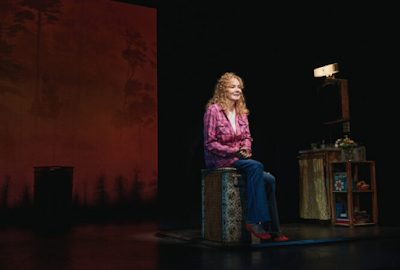
Showing posts with label broadway. Show all posts

Monday, August 24, 2026

Margin Notes 2026, W34: Heated Rivalry: The Unauthorized Musical Parody, The Winter's Tale, A Walk on the Moon, Paranormal Activity

8/17/26: Heated Rivalry: The Unauthorized Musical Parody
What: Exactly what it says on the tin. An unauthorized musical parody of the hit Canadian TV series about rival hockey players who fall in love.
And? So very stupid and so very fun. The songs were, by and large, enjoyable. As with Titanique, some fatigue did set in for me as things went on, but I still had a good time. It was fantastic to see Ryann Redmond and Jay Armstrong Johnson again, and standby Shelby Acosta was fan-flipping-tastic as Shane's Mom and others.

And now I have to go off-topic because I had no idea that "The Culture Club" is in the McKittrick's old space (home for over a decade to Sleep No More). So imagine my surprise when I climbed the stairs to the second floor lobby and found myself in what every cell in my body remembers as the hotel lobby floor. My memory filled in the blanks: there were the phone booths; there was the piano where Boy Witch sang "If That's All There Is;" there's the lobby desk where the Boy Witch cried on my shoulder; down that curtained-off hallway is the dressing room where the Bald Witch put on her wig, or where the Porter put on lipstick while staring at me through a mirror. Here I saw so many encounters, here I was swept away, again and again. Of course, the phone booths and piano are gone. The lobby counter remains but it is now a bar for patrons. There are more places to sit: squashy velvet chairs and couches. Periodically a host will approach guests in the lobby and invite them upstairs. We ride the elevator up to the sixth floor (!) but there is no old-fashioned wicker wheelchair, no upside-down model of the Manderley estate. The actual performance space is the old Club Car, which hosted the wonderful chamber production of The Woman in Black both before and after the pandemic lockdown; I saw that production four times, so even this brought back memories. Parts of the space have been redressed; parts have not -- I grabbed a quick photo of a wall covered in chalk tally marks, which confused the other patrons as we left the sixth floor via the long set of stairs. And one last remnant of the Sleep No More experience: a staff member at each open door as we took the stairs down, to make sure we did not wander away.

Sorry, I did enjoy the show, but the sense memory of being in that space again was a lot. Sleep No More meant so much to me in 2011 and 2012, when I kept going back again and again.

Jay Armstrong Johnson as Ilya and Jimin
Moon as Shane. Photo by Matthew Murphy.


What: Shakespeare in the Park presents one of the weird ones: the first half of Winter's Tale plays like a tragedy, where (spoilers) King Leontes's tragic flaw of overwhelming jealousy leads to the estrangement from his lifelong friend Polixenes, the banishment of his newborn infant Perdita, and the death of both wife Hermione and son Mamillius. The second half jumps forward sixteen years and plays like a light romance: Perdita is a sweet young shepherdess in love with Florizel, son of Polixenes; Leontes has been mourning faithfully the past sixteen years for his wronged wife. Also, this play features the famous stage direction "Exit, pursued by a bear."
And? The tonal reversal between the first half and the second is not managed as smoothly as I would like. By which I mean: the tragedy of the first half is performed heartbreakingly by Lily Rabe (Hermione), my beloved Raúl Esparza (Leontes), and Marsha Stephanie Blake (Paulina, the wisest character in the play). It's powerful and devastating and delicately crafted by director Daniel Sullivan, a SitP regular. The second half of the play is too bogged down in the clowns (no doubt meant to alleviate the heaviness of the first half) and I found all three of them profoundly tiresome. Perhaps in stronger comedic hands it would be less so (I recall Jesse Tyler Ferguson making a delicious feast out of the Young Shepherd's first monologue). So I did get impatient for things to wrap up, as we ventured into hour three, but I still consider the show worth seeing, if only for Lily Rabe's incredible performance in the trial scene. 

Marsha Stephanie Blake as Paulina, Lily Rabe as Hermione,
and Raúl Esparza as Leontes. Photo by Joan Marcus.


Tuesday, June 2, 2026

My Perennially Inaccurate Tony Predictions

It's been a thin season this year, especially as far as musicals are concerned -- it's always rather damning when two of the nominees for Best Original Score are plays rather than musicals. It's been a fatter season in terms of star power, which makes tickets harder to get ($400 for back of the orchestra is extortion). Accessibility issues aside, I'll admit I've been having a bit more fun with shows Off-Broadway rather than On this spring, but I missed my chance to do the Drama Desk predictions, so we may as well dive in. (Note: I missed Waiting for Godot, am bypassing Death of a Salesman and Dog Day Afternoon, and will not be able to see Rocky Horror Show until after Tony season. I saw Liberation during its Off-Broadway run, and did not end up making it to the Broadway transfer.)


Let's get to it!

Monday, June 1, 2026

Weekly Margin 2026, W22: Schmigadoon!

5/29/26: Schmigadoon!
What: The Broadway transfer of the TV show about Josh and Melissa, hiking in the woods after a failed couples' retreat to fix their problems, who suddenly find themselves -- Brigadoon style -- in a magical and enclosed village where -- pastiche style -- everyone is in a musical. The show follows the TV series' first season, where the musical style takes its cue from the Golden Age of musicals (chiefly the Rodgers and Hammerstein catalogue and Meredith Willson's The Music Man). They are cued by a leprechaun (hat tip to Lane, Harburg, and Saidy's Finian's Rainbow), who sings to them that they will not be able to leave until they have rediscovered true love. Melissa may adore musicals, but Josh hates them, so wacky chaos ensues, but since it's the Golden Age of musicals, we're guaranteed a happy ending.
And? I had such a great time. They manage to fit most of the songs from the TV show in, and the cast is an absolute delight (loved seeing Ann Harada reprise her role from the series as the Mayor's wife Florence). She's not the only return from the show -- choreographer Christopher Gattelli returns, this time to both direct and choreograph, and his skills are a perfect fit for this show. It's a bit odd to see Alex Brightman -- known for his larger than life performances in Beetlejuice and School of Rock -- play the straight man, but he is indeed also good at the dryly sarcastic rebuffs to the nonsense around him, with perfect timing (it's still weird to see him play the most grounded character in the show, but hey, I love Alex Brightman). Some of the tee-hee gay about the closeted Mayor still feels pretty 90s in its style, which isn't my favorite, but looking past that I still had a great time. I went into this with somewhat muted expectations, weighed down by the rampant cynicism that flavors so many screen-to-stage productions of the past decade, but with such faithful adherence to a show (especially one already steeped in tropes and styles lifted straight off a Broadway stage), this manages to be a success.

Alex Brightman as Josh, surrounded by the cast of Schmigadoon!
Photo by Matthew Murphy and Evan Zimmerman.


Monday, May 25, 2026

Weekly Margin 2026, W21: Well, I'll Let You Go, Proof, Cable Street, Fallen Angels, Titaníque, Cats: The Jellicle Ball

What: Studio Seaview hosts an encore presentation of Bubba Weiler's play about a newly-widowed woman receiving visitors one by one in the immediate aftermath of her husband's death.
And? This play owes a large debt to Thornton Wilder's Our Town, but it's more than able to pay it back: a narrator explains the layout of the main room in a farmhouse, pointing to a piano we can't see, a sectional couch that for us is just five folding chairs. He sets both the space and the mood in this way, bringing us gently into Maggie's suddenly small world. With each visit from a friend or relative, new detritus is brought into the house: used bowls and coffee mugs, a surfeit of white floral arrangements, an incongruous bouquet of purple balloons, a case of Coors beer, a wheelbarrow full of mulch, a stack of half-opened storage boxes. With each visit, more is unveiled about the man with whom Maggie spent most of her life, the man whom she may not have known as intimately as she thought. Surrounded by a mess as chaotic as the turmoil in her head, Maggie wonders when the last time was she had known real ease.

I really loved this one. It's so delicately and deftly crafted, treating Maggie with the gentle compassion she deserves while simultaneously brutally pulling out the rug from beneath her feet. Jack Serio's direction fully grounds the performances even in this ungrounded space, and earning the transformations revealed later on in the work. Weiler's play is a beautiful study in the stages of grief, and the mess of life we accumulate over time. The play could have been leading to an ending of devastation and emptiness, but instead -- it's still devastating because he's still gone, but it's not empty, what he left behind. The walls that were closing in on Maggie are fading away, leaving her air to breathe and a horizon to see. This play isn't sentimental in the way that Our Town, is -- it won't wallow in that -- but it still knows how to give space to loss. Quincy Tyler Bernstine is remarkable as Maggie, messy and frank and wounded and still here. Matthew Maher's narrator is warm and matter of fact, allowing the actor to stretch muscles I don't often get to see him stretch. Emily Davis, as the mysterious Angela, perfectly balances the tightrope of revelations and tensions her arrival brings.

Danny McCarthy as Jeff, Matthew Maher as Narrator,
and Quincy Tyler Berstine as Maggie. Photo by Emilio Madrid.


5/19/26: Proof
What: Thomas Kail directs the Broadway revival of David Auburn's Pulitzer-winning play about the daughter of a math prodigy, who may be either a math prodigy herself, or as mentally unwell as her father was at the end of his life.
And? It's really hard to get out from under certain shadows. I still have vivid memories from seeing the original Broadway run of Proof with Jennifer Jason Leigh. The hard cut to black after the final line of Act One. The dryness of Catherine's delivery, originated by Mary-Louise Parker, continued by JJL. The too-quick-to-seem-possible scene and costume changes. The sweetness and eagerness of Cathereine's romance with Hal. The genuinely worrying ambiguity regarding the validity of her story, and her quiet monotone voice as she reads aloud her father's proof. All of this remains crystalline clear in my memory, 25 years later. So it's not really fair. If this were my first experience of the play, I'd probably appreciate it a lot more -- it's an amazing play, perfectly constructed. This production is fine, Ayo Edebiri is continuously vibrating as Catherine (simultaneously compelling and exhausting to watch), and Teresa L. Williams's scenic design is striking even if it never lives up to its original promise. The production is fine but it is unable to eclipse my memories of the original run.

Ayo Edebiri as Catherine, Don Cheadle as Robert, and Jin Ha
as Hal. Photo by Matthew Murphy.


Monday, May 18, 2026

Weekly Margin 2026, W20: American, Italian, Giant, Joe Turner's Come and Gone, MCC Miscast 2026

5/11/26: American, Italian
What: SOOP Theatre presents the world premiere of Anthony P. Pennino's new play, as part of The Chain Theatre's 2026 The Factory Series. Pennino's play follows a family of second- and third-generation Italians, as teenager Gio and his older cousin Vin attempt to navigate the expectations of their fathers and their own inner demons. As Vin descends into addiction, Gio tries to keep him from drowning.
And? full review here.

Donovan Counts as Gio and Dante Palminteri
as Vin. Photo by Grace Romanello.


5/12/26: Giant
What: Mark Rosenblatt's play exploring celebrated children's author Roald Dahl and his antisemitism, in the wake of his incendiary book review of Tony Clifton's God Cried, in which equated Jewish people with Nazis.
And? I was pretty wary going into this show, and I don't think I would have gotten a ticket without having it vetted by more than one Jewish friend. I was worried the show would somehow try to let Dahl off the hook, on the strength of his writing and how much his books mean to people. I was also worried I'd be sitting within a hostile audience ready to applaud some of his rhetoric, since antisemitism has become more and more permissible in recent years. But the audience was very well-behaved, not stopping the dialogue to applaud certain arguments, as if we were watching a debate (I really hate how often that happens at shows these days -- it happened a lot when I saw The Ally and it was distracting and disheartening). And Giant does not let Dahl off the hook. A note in the program indicates that, while aspects of the play itself are invented, both the text of his review and every word of the phone call that ends the play are verbatim. There is no hiding from what he said, in print and on the record to a reporter. And, as a great relief to me, the repudiation of his outrageous statements, delivered by a young Jewish woman representing his publisher, is clear and firm--and is everything I wish I could say to the people spouting hate-speech at every Jewish person they see. Chillingly, every cruelty spouted by Dahl is one we're still hearing today, with new rigor. Forty years after the founding of Israel as a sovereign state, Dahl was calling for its dissolution; forty years later now, people are calling for that yet again. Everything old is new again, and I wish this play wasn't as timely as it is.

John Lithgow is perfectly cast as Dahl -- not just because he bears an uncanny resemblance to the man, but because he moves so effortless, almost imperceptibly, from the avuncular if tetchy beloved children's book author to a chilling manipulator, glaring out with cold reptilian loathing and spitting insults like he's throwing darts in a pub. We knew Lithgow had that ability to turn on a dime from his run as Trinity on Dexter, but it's a treat to see him do it live in front of us. A treat, and profoundly unnerving. Aya Cash, as the main focus of his venom, is a worthy adversary, masking her iron spine with the friendly and slightly apologetic veneer women in the corporate world often adopt to smooth any ruffled feathers.

Aya Cash as Jessie Stone and John Lithgow as Roald Dahl.
Photo by Joan Marcus.


Monday, May 11, 2026

Weekly Margin 2026, W19: The Emporium, The Fear of 13, The Censorship of Dreams, The Totality of All Things

5/05/26: The Emporium
What: Classic Stage Company presents Thornton Wilder's unfinished final play about a young orphaned man who dreams of working at an enigmatic department store called The Emporium. Everything is profoundly metatheatrical and self-aware.
And? It's pretty slow, and requires patience for the way in which the story is told. A number of people left at intermission, so it's definitely not for everyone, but I was interested enough to stick around for the whole show. Some of the self-awareness gets a bit twee, and I do wish we could have had Wilder's full intended version of the play, rather than this combination of his drafts and notes and Kirk Lynn's completion of the script. It's a bittersweet exploration of idealism and compromise, and the eternal promise of trying again, and maybe getting it right next time. It lands a bit unsatisfactorily at the end, but I'm still glad I saw the show.

Eva Kaminsky, Derek Smith, Candy Buckley, 
and Mahira Kakkar. Photo by Marc J. Franklin.


What: Based on David Sington's documentary, Lindsey Ferrentino's play traces volunteer Jacki Miles's series of visits to Nick Yarris, a man on death row for a murder he claims he didn't commit. Through their conversations, both in person and later over the phone, the play offers a non-linear lookback on the tumultuous youth of Yarris and the poor decisions that led him to spending two decades in prison.
And? David Cromer truly is an excellent director, consistently crafting ensembles into one beautifully cohesive entity, all telling the same story and in the same world (this may sound like a "duh Zelda, that's what directing is," but the last time I saw Tessa Thompson on stage, she and her costars were all awful and because they were all awful in the same way, I blame that director). Adrien Brody and Tessa Thompson do excellent work leading the cast, both performers offering quietly understated but deeply felt portrayals of Nick and Jacki. There's one scene in particular, as they're both struggling to keep that stiff upper lip in the face of a new devastation, that just broke my heart. It's also always a treat to see Ephraim Sykes and Eddie Cooper onstage, albeit in small roles, especially when they're able to let their voices fly. Arnulfo Maldonado's scenic design, especially under Heather Gilbert's precise lighting, is evocating and haunting without overwhelming the story being told (but goddamn, that one stool ... the final moment with that stool kind of wrecked me). The play itself inside these strong storytelling elements is fine, though some moments feel shoehorned in to achieve faithful adherence to the narrative of the documentary, rather than taking narrative liberties that come with any adaptation, to tell a coherent story.

The  cast of The Fear of 13. Photo by Emilio Madrid.


Monday, May 4, 2026

Weekly Margin 2026, W18: The Lost Boys, You & Me, Bat Out of Hell, Merrily We Roll Along

4/28/26: The Lost Boys
What: A new musical adaptation of the classic 80s film about vampires.
And? Honestly? I had a great time. Is it a great show for the ages? Debatable. Did I stop listening to lyrics half the time? Maybe. Are the central couple strong actors or can they just sing really well? Very much the second option. Did the final moment annoy me deeply, only to be chased by a post-bow moment that annoyed me even more? Yeah you betcha yeah.

But really, I had a great time. Fantastic stagecraft, especially as it takes advantage of how damn tall the Palace is, both from an audience perspective and the stage itself. We were midway up the mezzanine and still had a great view, with the staging and design utilizing to great advantage three different levels of their scaffolded set. The flying looked fantastic and not even silly. David (the blond Kiefer Sutherland vampire) was properly threatening and charismatic--Ali Louis Bourzgui can do no wrong, as far as I can tell. The show leans into the campier aspects unapologetically, especially in the ridiculous Act Two opener (no spoilers). The Frog Brothers (Jennifer Duka and Miguel Gil) are delightful, younger brother Sam (Benjamin Pajak) is adorakable, Paul Alexander Nolan perfectly walks the subtle line of video store owner Max, and the always-excellent Shoshana Bean belts to the ceiling and back again. I don't remember the film well enough to speak to the musical's faithfulness to the source material, but Sax Guy is there, and they successfully translate a film's three-act structure into a musical's two-act structure.

So, a few nits to pick, mentioned above, but still fun theater.

LJ Benet as Michael and Ali Louis Bourzgui as David, with
the cast of The Lost Boys. Photo by Matthew Murphy.


4/29/26: You & Me
What: A year after college student Delilah opened fire on campus, killing eleven people before killing herself, friends of both the murderer and the deceased gather for a memorial at their local diner. Attendees include Delilah's twin sister Chloe, her ex-girlfriend Mac, and a movie star in town to research an upcoming role. Over the course of one day, Chloe continues her pursuit to uncover why her sister did what she did, and friends and enemies alike reveal damning truths along the way.
And? full review here.

Courtnie Keaton as Mac and Brianne Buishas as Chloe.
Photo by Filip Rucewicz.


Monday, April 27, 2026

Weekly Margin 2026, W17: What Happened Was ..., Every Brilliant Thing, Becky Shaw, The Most Spectacularly Lamentable Trial of Miz Martha Washington

What: Audible's Minetta Lane Theatre presents a revival of Tom Noonan's two-hander about an awkward first date between two coworkers who both feel a bit at sea in a life that hasn't turned out how they thought it would.
And? Great performances from both Corey Stoll and Cecily Strong, particularly Strong's reading of her character's grim and explicit "children's story." I appreciate that the play doesn't attempt to land on a sweet button that has not been earned by the preceding moments. Instead, it chooses to highlight the persisting loneliness of both characters, whether or not they will ultimately be able to cross their divide to find companionship in each other.

Corey Stoll as Michael and Cecily Strong as Jackie.
Photo by Evan Zimmerman for MurphyMade.


What: Duncan Macmillan and Jonny Donahoe's one-person interactive show, currently starring Daniel Radcliffe (but soon to be starring Mariska Hargitay), about a young man's attempt to reckon with his mother's recurring uncompleted suicides and his own depression, by making a list of "every brilliant thing" that makes life better. A number of audience members are drafted, to either read out individually numbered brilliant things (number one is ice cream), or to play characters in the young man's life, including father, spouse, and a nice couple in a hospital who give him a juice box (which he promptly returns because he doesn't like it).
And? Radcliffe is everything charming, a ball of energy whose battery never seems to peter out, even when getting into the heavier parts of the story. But in all honesty, even with its purportedly heavy topic, the play itself never feels that heavy. The concept/conceit of the show is exciting, but suffers in execution (it's often hard to hear the brilliant things being called out by audience members, and the audience-character-stand ins are, of course, inconsistent). And the whole thing just lacks a certain heft for it to really follow me home. I'm not saying I needed the gut punch of Macmillan's other work, People, Places and Things, but PPT knew how to land satisfyingly. EBT has a lighter heart than PPT, but it should still be able to land satisfyingly. It was a fine time, but not a great time.

Daniel Radcliffe. Photo by Matthew Murphy.


Monday, April 13, 2026

Weekly Margin 2026, W15: Echoes of My Silence, Scorched Earth

4/09/26: Echoes of My Silence
What: As part of the Frigid/New York City Fringe Festival, Azadeh Kangarini's autobiographical one-woman show plays at the Chain Theatre. Her piece follows the path of her silence in the face of externalized and internalized misogyny through the various men whose molestations through the years of her life have made her question herself and her own relationship with her body.
And? full review here.

Azadeh Kangarani. Photo by Nathan Zhe.


What: St. Ann's Warehouse presents Attic Projects' production of Luke Murphy's choreographic play about a cold case over a death ruled accidental at the center of a land dispute in Ireland.
And? Absolutely stunning choreography: fluid and athletic and almost weightless, bodies seeming to be falling up from the ground, a collapse in reverse. The dance often separates itself from literal storytelling, dilating emotional moments and crises, fixations and mysteries. So while the ostensible frame is the 24 hours a man is held for questioning as a cold case is reopened in which he is the prime suspect for a murder, there are diversions to the late night walker who found the body, the damage to the body itself, the missing donkey, and the farmer's affection for the land he's losing that volleys between love and desire: a distinction noted in the work of giving versus taking. The final sequence, as the walls fall away to reveal the tract of land, a steep hill with a deep loam, is a gorgeous expansion of space and bodies in motion.

The company of Scorched Earth. Photo by Teddy Wolff.

Monday, April 6, 2026

Weekly Margin 2026, W14: Beaches, The Balusters

3/30/26: Beaches
What: A new musical adaptation (with lyrics and co-written book by Iris Rainer Dart, the original novelist of Beaches) of the beloved 80s film about two best friends whose wildly different personalities and paths lead them to connect, disconnect, and ultimately unite in their lifelong affection for each other. It's also the movie that gave us "Wind Beneath My Wings."
And? It's fine. The score isn't memorable and the script is serviceable, but the performers are excellent, particularly Jessica Vosk and Kelli Barrett as the adult versions of Cee Cee and Bertie, and Samantha Schwartz and Zeya Grace as their childhood counterparts. Also of note: the rarity of a musical with only two male performers (it's a small cast in general, but that's still impressive). Sadly, another show with an unimaginative use of projections and screens.

Jessica Vosk as Cee Cee and Kelli Barrett as Bertie.
Photo by Trudie Lee.


4/01/26: The Balusters
What: MTC presents David Lindsay-Abaire's new play about the Neighborhood Association of a community of houses in a historically preserved neighborhood, as they struggle with maintaining the faithfulness to the aesthetic against the ever-changing progress of time: here encapsulated in the need for a stop sign on an otherwise preserved esplanade, and the controversial installation of non-historically accurate balusters (porch railings).
And? Honestly just a fantastic night out -- good, messy fun. The play accomplishes a fantastic feat of a true ensemble work where every performer gets a chance to shine, where every character has admirable qualities and more despicable ones. There are no heroes here, but nor are there villains. These people are a damn mess, and it makes for very good theater. It's hard to talk about standout performances, but Marylouise Burke (who also starred in the original play version of Lindsay-Abaire's Kimberly Akimbo) is an absolute dotty gem, delivering even the simplest lines with her own unique spin. And the two primary antagonistic forces, Richard Thomas as the board president and ardent advocate for preservation and Anika Noni Rose as the newcomer ready to stir things up, are perfectly polarized: each with an ironclad conviction that they are on the correct side of the argument, each cunning enough to try to outwit the other.


Monday, March 2, 2026

Weekly Margin 2026, W9: Cold War Choir Practice, Marcel on the Train, Antigone (This Play I Read in High School), Hate Radio, Bug, The Other Place, Operation Mincemeat (Blizzard livestream)

2/25/26: Cold War Choir Practice
What: MCC, Clubbed Thumb, and Page 73 present Ro Reddick's play about Meek, a young Black girl in her local Cold War Choir (apparently this is a real thing), who gets caught up, along with her aunt, in intrigues involving the Soviet Union and a cult.
And? So there's a lot going on. It's a strange but interesting show with engaging performances, especially Alana Raquel Bowers's straightforward and sweet Meek, and Grace McLean's sly and purring Choir slash cult member. I don't quite know what to take away from the show, but it was a fun ride along the way.

Alana Raquel Bowers, center, as Meek, with Suzzy Roche,
Grace McLean, and Nina Ross as the Choir. Photo from the
Summerworks production by Maria Baranova.


What: Ethan Slater co-writes (with director Marshall Pailet) and stars in bioplay about a young Marcel Marceau's role in the French Resistance during the German occupation of France during WW2, as he helped Jewish children escape Nazi capture.
And? It's really quite an extraordinary piece of history on its own, and one I hadn't heard. Scenic Designer Scott Davis evokes the train car in which Marcel escorts the four orphan children with a wooden platform and benches, and a curved metal scaffolding overhead to represent the train's roof. This is where we are for the whole show (with a few flashbacks and flashforwards): a place with no apparent escape but also no evident protection. The ceiling is an illusion, the walls invisible. Studio Luna's lighting design plays dramatically with light and shadow, creating a world where darkness is safer than the threat of light. Against this, director Marshall Pailet crafts a taut 100-minute production, with each raised voice a potential siren to bring on capture and execution, while also teetering over a future uncertain enough that--even knowing Marcel Marceau goes to become a world-renowned mime--survival does not feel guaranteed. And indeed, with the flashforwards we see that no one escapes this time unscathed or free from trauma. Are these flashforwards the truth, or only what the children hope for--what Marcel hopes for?

The four children we see Marcel ushering are fictionalized but each serves as an interesting foil to the twenty-year-old man (in addition to being fully realized characters on their own): Henri (the sweet and funny Alex Wyse), whose gift for blather and determination to survive inspires a self-doubting Marcel to keep moving forward with his mission; Adolphe (my favorite, Max Gordon Moore), a preteen with a strong sense of right and wrong, and a distaste for lying, who holds Marcel accountable for his responsibility to four vulnerable children; Etiennette (a mute but expressive Maddie Corman), terror-struck but drawn out of her shell by mirroring Marcel's playful impulses and clown work; and Berthe (the always wonderful Tedra Millan, here bringing a brittle brine to her performance), whose blend of pessimistic and realistic perspective force Marcel to extend himself beyond gentle play into action and decision. Aaron Serotsky, who plays Everyone Else, brings an especially terrifying energy to the Nazi search of the train car, delicately tip-toing along the line between a benevolent authority figure performing an unfortunate necessity, and a snake waiting patiently for his prey to stumble in biting range. As the titular Marcel, Slater beautifully embodies the charisma and showmanship, while also delving into the vulnerability of a young man only just out of his teens, risking not only his life but the lives of children unable to protect themselves.

Tedra Millan as Berthe and Max Gordon Moore as Adolphe.
Photo by Emilio Madrid.


Monday, January 26, 2026

Weekly Margin 2026, W4: Two Strangers (Carry a Cake Across New York), The 25th Annual Putnam County Spelling Bee, Murder at Midnight

1/21/26: Two Strangers (Carry a Cake Across New York)
What: The Broadway transfer of the West End two-hander musical about a young British man visiting New York for the first time to attend the wedding of a father he's never met, and his antics with the sister of the (much younger than the groom) bride.
And? It's cute. It's definitely cute. Both actors are doing good work (nice to see Christiani Pitts again). I like Soutra Gilmour's seemingly simple but magic box surprise of a scenic design. Several of the songs in the second half are clever. But I was not in a good headspace when I saw this--which is not the show's fault--so I found a lot of the humor unimpressive, the plot turns predictable, the first half of the score unsurprising, and the piece as a whole not unusual enough to transcend any of that. Someone said to me it's being described as this season's Maybe Happy Ending, and I can see that, in terms of a small-cast chamber musical telling a sweet story of two polar opposite people on a quest learning to appreciate each other. But Two Strangers slides closer to a number of movies I've already seen, whereas MHE surprises in staging, scenic and projection design, clever lyrics and earned character arcs, and ultimately managing to skirt a number of predictable archetypes of this type of story to show us something new.

Two Strangers doesn't show us something new, even if it is charming enough at what it's showing us. I don't want to come down to hard on it. But I think it got overhyped for me, and then with my brain being what it was when I saw the show, I was underwhelmed.

Christiani Pitts and Sam Tutty as Robin and Dougal.
Photo by Matthew Murphy.


What: The Off-Broadway revival of Rachel Sheinkin and William Finn's adorable musical about, well, what the title says, and the oddball kids who compete.
And? A perfectly fine and fun revival, if not particularly transformative. The sweet and tart nature of the show remains intact, as well as the humor. And it's good to hear this score live again. I had hoped to catch Justin Cooley, a delight in Kimberly Akimbo, but he was out; luckily, his understudy Jahbril Cook did excellent and endearing work. The contemporary script updates were mostly fun, and a good way to keep surprising people who already know the show well from its original run. I particularly enjoyed a number of the women in the cast: Jasmine Amy Rogers (Miss Betty Boop herself!) is an endearingly earnest Olive without being cloying, Leana Rae Concepcion's Marcy is a hilarious taut wire until her euphoric explosion in my favorite song in the show, "I Speak Six Languages," and the always excellent Lilli Cooper is polished, wryly funny, and in excellent voice as the bee's emcee Rona Lisa Peretti. My one real beef with this production is the missed opportunity seized by the original production. When this show first arrived on Broadway back in the aughts, it featured three principal roles played by larger bodied actors. It was great representation of three talented performers (and their talented understudies and replacements--I got to see Josh Gad), and there were no jokes made about their size. With this revival cast, there is none of that, and it's a damn shame.

The company of The 25th Annual Putnam County Spelling Bee.
Photo by Joan Marcus.

Streaming Theater

Monday, January 5, 2026

Weekly Margin 2026, W1: Marjorie Prime, Twelfth Night

1/03/25: Marjorie Prime
What: 2nd Stage revival of Jordan Harrison's play about Marjorie, a woman in her 80s with Alzheimer's interacting with a new technology of holographic people called Primes who are taught to be the embodiment of lost love ones, through the stories told to them by those who still remember. Marjorie's adult daughter Tess struggles with the idea of this technology, both as an evocation of her dead father and as an imperfect and filtered version of reality: a Walter who is taught a gussied up version of his marriage to Marjorie and who isn't told about his son Damien who died many years ago.
And?  The wildest thing about this play to me is that it was written years before ChatGPT existed, because it seems like such a good conversation piece to have in regards to that particular AI application, full of half-truths culled from many sources, but also full of hallucinations (and frankly terrible counting skills--ask my sister). Walter Prime tells Marjorie the story of the night he proposed, but Marjorie asks him to overwrite it so they saw Casablanca rather than My Best Friend's Wedding. The death of their son Damien irrevocably changed the entire family, and yet Marjorie hasn't spoken Damien's name since he died. Walter Prime learns from her the story of their marriage, their daughter, their two dogs, but not a word about their son. And as each memory is overwritten with a newer glossed-over draft, it steps further and further away from reality and into the realm of fairy tales. Spoilers ahead, so stop reading now if you don't want them! As each subsequent character passes away, to be reincarnated into their blank page version to be written and rewritten, we step further and further away from reality: each new self has softened edges, removing conflict and unkindness, erasing trauma and baggage for theoretically easier communication, but instead creating smudged carbon copies. In the final sequence, the three remaining Primes sit around a table telling each other their stories, each one not quite true, but yet in full consensus. It's an excellent demostration of the inferiority of AI art to human-created art: AI art can regurgitate and collage, but it cannot invent, whereas human-created art can do both. The final sequence of these three Primes in their loop of half-truths and elided facts also got me thinking about the line I heard once, that you only truly die when there's no one left alive who remembers you (Tom Stoppard's Leopoldstadt explores this theme beautifully). Here at the end when only Primes remain, with no one left alive to remember Damien, the poor unhappy son is dead at last.

June Squibb and Cynthia Nixon as Marjorie and Tess.
Photo by Joan Marcus.


Streaming Theater
  • Shakespeare in the Park's summer production of Twelfth Night, hosted on PBS.

Tuesday, December 16, 2025

Best Theater of 2025: Another Year End, Another List

Hello hello and it's time for another year-end round up of my favorites of all the theater I saw in 2025. I've been thinking this month about what a shame it is that the Fall season brings us so many strong pieces of theater, many of which don't survive past the new year for one reason or another (if it's a star-studded play, it's often a limited run anyway), and can therefore be forgotten come awards season, even if they're remembered fondly for these end of the year Best-Of lists. But then, I wonder if the weightedness of the Spring season representation at the Tonys et al is mirrored for the year-end lists. Do Spring shows that burned brightly but briefly make the cut? (Not to brag, but it looks like my list is almost evenly divided between first half of the year and second half. Go me!)

This is just me musing. I haven't run the numbers. But hey, speaking of numbers, this year I saw 128 pieces of theater with 9 repeats, leaving 119 unique pieces of theater. Of those 119, 70 were plays, 39 were musicals, and 10 were streaming.

In order of appearance, these ones stuck around in my brain, my heart, and/or my gut.

Monday, December 1, 2025

Weekly Margin 2025, W48: Oedipus, Chess, The Seat of Our Pants, Art, Marilyn Maye at 54 Below, Little Bear Ridge Road, The Baker's Wife, Ragtime, Masquerade, Archduke, A Christmas Carol at the Merchant's House

Buckle up, folks, it's the Thanksgiving week roundup!

11/24/25: Oedipus
What: Roundabout hosts the West End hit adaptation of Sophocles's  play, translated by director Robert Icke into a contemporary political thriller. Oedipus here is an idealistic politician on the final day of his campaign for office, with his wife on his arm, his brother in law advising him as speechwriter, his three children in attendance, and his mother as an unexpected visitor. In the wake of his campaign promises to release his birth certificate and to solve the mystery behind his predecessor Laius's sudden death thirty-four years ago, secrets are unwillingly dragged into the light, and well--you know the story right? Everyone knows the story here.
And? While I've had a mixed experience with Icke's work in the past, this adaptation and production are extraordinarily good. Mark Strong and Lesley Manville are doing such fully realized work, you forget they're actors. Oedipus and Jocasta are genuinely in love and  they truly want to do good; and despite any damages he may incur, Oedipus is dead set on finding out the truth and doing right by it. Which, of course, is what you need to make the agony of a Greek tragedy work. Lesley Manville in particularly is absolutely heartbreaking as you see the realization of the full truth register on her face, in her gut. I couldn't take my eyes off her.

The production itself outside of the performances is also very well structured: a formerly pristine white space with rotating walls and large glass windows, full of the stuff and chaos of campaigning. As these are gradually cleared, all of the furniture being slowly moved out, we become aware of the lie of transparency in this space, of the obstacles to clear sight and truth. But we also approach closer to the purity of that truth, the clean white space where there is nowhere left to hide. Meanwhile (not subtly, but still effectively) a large digital clock counts down the minutes until the results of the election come through and his victory is assured. It is also, we know, counting down the minutes until the truth is revealed. And indeed, the clock hits zero when Jocasta tells Oedipus who he actually is and what he's done.

Just excellent work all around.

Jordan Scowen, Olivia Reis, Mark Strong, Lesley Manville,
James Wilbraham, Anne Reid, and Bhasker Patel as Eteocles,
Antigone, Oedipus, Jocasta, Polyneices, Merope, and Corin.
Photo by Julieta Cervantes.


11/25/25: Chess
What: Danny Strong's rewrite of the notoriously messy but beloved musical makes its way to Broadway, starring Lea Michele, Nicholas Christopher, and Aaron Tveit. What is it about? Depends on the version you're watching but the tl;dr is: chess literally and also as a metaphor for Cold War machinations, and also there's a love triangle that is actually a quadrangle.
And? I don't know what to tell you guys. Well, I do, but I'm disappointed to do it. It's so weird, I remember liking Danny Strong's revision to the book in DC. Was I wrong, or have they kept working on it to the degree that it's reverted back into a mess again? This script feels both overwritten and underwritten: the Arbiter's narration is too peppered with tired references to today's political woes and too dumbed down to the lowest common audience denominator. On the flip side of that, the dialogue scenes that remain are so underwritten that the rest of the cast has almost nothing to work with. Svetlana is reduced to a mustache-twirling sex kitten (though I lay the blame for that not only on Strong but also director Michael Mayer). Shakespeare Forum's credo is that "love is the strongest choice." If there's no actual love left between Svetlana and Anatoly, where is the tension on whether or not he should return to the USSR? Meanwhile context has been broken enough that Florence's big second act solo, "Someone Else's Story," is completely isolated from any other scene such that it may as well be a concert performance on PBS (granted, the lyrics are generic enough that the song can be reassigned to anyone else and still pretend to make sense). Florence walks out on stage, stands and delivers, the audience cheers, and off she goes again. I also don't understand either the song's placement in the eleven o'clock spot, or why it's played so positively. She's about to lose the love of her life and she knows it. Florence is--and I think always has been--let down by the script. She's meant to be the main character, but nearly every action she takes is in service of someone else, always a man. You can argue that the point of the story is that they're all pawns being controlled and sacrificed by the officers of the state, CIA agent Walter and KGB agent Molokov, but in that case wouldn't a great arc be Florence stepping away from pawn status and becoming the queen she should be? Guys, wouldn't that be nice? They claim she's one of the best chess players in the world. Why isn't she better at this kind of strategy?

Actually let's talk a bit more about that "what action are we playing here" question. "I Know Him So Well" is one of my favorite two-woman duets in musical theater. It just sounds so lovely. But it should be about both Florence and Svetlana realizing (or thinking they realize) that they can't hold onto Anatoly. Florence sings "he needs security" because she believes he will leave her and return to his wife; Svetlana sings "he needs his fantasy and freedom" because she believes he will never return home but continue to wander the world as a refugee with a lover, not a wife. That's what the lyrics mean. And again, that's the exciting tension, both fully convinced they know him so well while also demonstrating he remains unknowable. If they're both playing the song like Florence has already won, what am I watching? Why are they doing this to Zelda?

Back to the Arbiter (this review is as messy as the show). At first I loved the use of his role: narrator and puppet master I could get behind (excellent use of him with the choreography of the ensemble), but treating his role like someone spoon-feeding Cold War politics to first graders grated on me almost immediately. Either trust the show or don't; either trust the audience or don't. Either do a concert or do a show. 

And the design! Let's pick on them too (this is turning into the rant I did about Company a few years ago). The scenic design is pretty sparse and concert-y, which, fine, I guess. However, there is a moment in the first act when a full bed with headboard appears out of the trap in the floor. I thought, "ah, things are finally real and concrete because their connection is concrete and real, and the aesthetic is about to transform." Nah. Back to minimalism after that. So I don't understand that choice. I also don't understand the costume design. Are we playing with black and white chessboard color palette or aren't we? Is Svetlana's burgundy dress meant to show she doesn't belong on the chessboard? Then why is she given calculated moves? I just ... come on, y'all, tell a coherent story. 

"Other than that, Zelda, how was the play?" Incredible performers. Truly. These voices are unreal. Sean Allan Krill as Walter isn't given enough to do for his talent, but he makes a meal out of what he has. Likewise, as his USSR counterpart Molokov, Bradley Dean gets to shine the way he deserves. Though I was routinely annoyed by the lines handed to the Arbiter, Bryce Pinkham remains a delight onstage. Lea Michele's Florence is let down by the writing, as ranted above, but what an absolute treat to hear her put her mark on this score. She knows how to texture a lyric: when to keep it close and intimate and when to belt it out. Aaron Tveit's Freddie is appropriately a mix of insufferable and charismatic enough to make you want to forgive him. He's excellent throughout (and has a fun bit of costume choreography in "One Night in Bangkok"--guys, I know they can't cut this song because it's the biggest hit from the show, but they really should cut this song if they want to script to ever actually work), and really lets everything explode in his big second act number "Pity the Child." And Nicholas Christopher as Anatoly? This is a star-making role. He's been quietly on the rise for a while now and it's such a gift to see him claim the spotlight the way he deserves. He has such physical restraint, cool as a cucumber, which makes it all the more powerful when he finally lets loose his rafter-shaking voice. His "Anthem" was unlike any other rendition of that song I've heard.

Aaron Tveit as Freddie with the ensemble of Chess.
Photo by Matthew Murphy.


Monday, November 24, 2025

Weekly Margin 2025, W47: Kyoto, Playing Shylock, Beetlejuice, Sweet Smell of Success

11/18/25: Kyoto
What: Lincoln Center presents Joe Murphy and Joe Robertson's play about the lead up to the Kyoto Protocol (an international agreement to limit carbon emissions to stave off climate change), and Don Pearlman, the man who tried to stop it.
And?  Dynamically staged with overlapping scenic transitions, this play reminds me a lot of another historical drama to play the Mitzi E. Newhouse theater, Oslo. Though this one has a more sinister bent: whereas the protagonists in Oslo were idealists, aiming toward unity and peace, Pearlman is a cynic whose goals are chaos and disunity. As he narrates the piece, we are with him the whole time, and it's a bit like keeping pace with Iago or Richard III. Stephen Kunken, always excellent, really shines as Pearlman, constantly moving, shifting gears, and looking for the next way in.

Stephen Kunken as Don Pearlman and the cast of Kyoto.
Photo by Emilio Madrid.

11/19/25: Playing Shylock
What: Theatre for a New Audience hosts Mark Leiren-Young's one person play starring Saul Rubinek, a mix of fact and fiction as Rubinek refuses to perform the second half of Merchant of Venice, talking instead about the thorny subject of antisemitism and Jewish representation, as well as a retrospective on his life as the son of Holocaust survivors.
And? This play needs some serious reshaping and editing. It can't seem to decide what it wants to be. Is it a loving tribute to Rubinek's father, an orthodox Jewish actor of Yiddish theater who survived the Holocaust only to emigrate to Canada where there was no Yiddish theater? Is it a moment for Rubinek to muse on the complicated nature of representation and performance of Jewish identity? To have a straw man argument about cancel culture (I'm not saying there isn't a discussion to be had about the unnuanced nature of cancel culture, but the one he was having didn't feel grounded in a real moment)? To explain to us in detail why Edward de Vere wrote Shakespeare's plays? To perform the grief of having a play's run get cut off midway through the suddenly final performance? Or perhaps just to showcase how good a Shylock Rubinek can perform, both in English and in Yiddish?

See, that's a lot of things. And while some of them work on an individual level, they're not cohering well into one moment that feels organic. Perhaps it would benefit from having Mike Birbiglia take a swing at the shape of it, when the art of Storytelling crafts a larger conversation with many side streets along the way. I sense also that both playwright and actor feel very precious about a lot of moments that don't necessarily belong as part of the larger thrust. It feels meandering and unfocused, a bit too much like if Saul Rubinek went onstage and actually just rambled for two hours; and for that matter it's got a good collection of inaccurate information, one of which I pointed out during an audience participation moment and which he dismissed as "close" because it didn't feed the way the script was actually written.

His performance of Shylock's monologues were great though.

Saul Rubinek as himself. Photo by Dahlia Katz.


Monday, October 27, 2025

Weekly Margin 2025, W43: Punch, Truman vs. Israel, Theater in Quarantine: Phantom of the Opera

10/22/25: Punch
What: Manhattan Theatre Club hosts the Broadway transfer of James Graham's adaptation of Jacob Dunne's Right From Wrong, about a young man whose punch in a brawl inadvertently causes the death of the man hit, and the aftermath of the asault, his time in prison, and the time afterward.
And? Due to a combination of jetlag and insomnia the previous night, I had a great deal of difficulty taking in this production and unfortunately can't do a write up of it. I'm sorry; the show deserves better and I wish I could have given it that.

The company of Punch. Photo by Matthew Murphy.


What: A fictionalized encounter between Bella Abzug and Harry S. Truman as Truman contemplates a libel lawsuit against journalist David Rosenfeld.
And? full review here.

Helen Laser and Willy Falk as Bella Abzug and Harry S. Truman. Photo by
Darin Chumbley.


Streaming Theater Content

Monday, September 22, 2025

Weekly Margin 2025, W38: The Other Americans, Improvised Shakespeare, Weather Girl, When the Hurlyburly's Done (ЯК СТИХНЕ ШУРУ-БУРЯ ЗЛА), Crooked Cross, BC/EFA Flea Market

9/16/25: The Other Americans
What: The Public Theater presents John Leguizamo's newest piece, a family drama set in Forest Hills (Queens, NY to you out of towners) where the patriarch is struggling to balance his empire ambitions for his set of laundromats against the return of his deeply traumatized son, still processing a violent and racist attack in one of the family's laundromats.
And? My immediate thought is that it's Leguizamo's take on Arthur Miller's Death of a Salesman: a mediocre man who keeps waiting for the American Dream to bless him with the bounty he expects. The key difference for me is, Miller (or at least Loman's wife) think Willy Loman was a man who deserved more and didn't get it; Leguizamo sees Nelson's flaws more clearly: he has disappointed hopes, racism has definitely been an obstacle to his ambitions, but he is also a bad business man and a neglectful father. Nelson is responsible for his own ruin. It sucks, and you can see his charisma and why he's loved, but he's still the textbook tragic hero: a man who brings about his own destruction, and the destruction of his loved ones.

The other piece of my immediate thought, comparing this to Salesman, is that it's not my favorite kind of story. But that's okay.

Meanwhile, the craft of this production is truly excellent. Anyone who reads my blog knows how ornery I get when a director doesn't know how to activate a non-proscenium space. The Anspacher space at the Public is a three-quarter thrust stage, with the turns at right angles. I had a seat at the extreme end of one of the sides, and I swear director Ruben Santiago-Hudson crafted moments that were just for me to witness. That's how aware he is of every view in the space. Were there times I couldn't see what was going on? Yep, pretty much everything in the kitchen was hidden from view. But otherwise, I really did feel like I was getting a special experience. Scenic designer Arnulfo Maldonado doesn't make it easy for Santiago-Hudson, but both of them accomplish wonders anyway, giving us powerful stage picture after stage picture.

So even if it's not my favorite kind of story, this was a truly excellent execution, from writing to staging to designing to acting.
Foreground: Rosa Evangelina Arredondo and John Leguizamo as Norma
and Nelson. Background: Bradley James Tejeda, Luna Lauren Velez, and
Rebecca Jimenez as Eddie, Patti, and Toni. Photo by Joan Marcus.


What: A ridiculously talented group of five players improvise an entire Shakespeare-style play, based on a title prompt from the audience.
And? "Beneath the Other Castle" was an absurdly funny tale of betrayal, bastards, and a baby. Because I'm approaching this as a theater-goer and not an improv maven, I always have the thought "I'd love to see this again." But that's not how improv shows work, Zelda. But I also know that the next time I see them perform will be just as absurd and hilarious.

(visible) Blaine Swen, Brendan Dowling, and Joey Bland carry Ross Bryant.
(I assume Steve Waltien is the face we can't see). Photo source.


Monday, August 25, 2025

Weekly Margin 2025, W34: Six, Death Becomes Her, Operation Mincemeat

 8/22/25: Six
a repeat visit, but five years later (it was the last musical I saw before Broadway shut down in March 2020).


a repeat visit

a repeat visit

Monday, July 14, 2025

Weekly Margin 2025, W28: Joy, Pirates! The Penzance Musical, Operation Mincemeat, Call Me Izzy, Purpose, John Proctor is the Villain

7/07/25: Joy
What: A new musical adaptation of the story of Joy Mangano, entrepreneur and inventor who made it big on QVC.
And? It's mid-previews, so I don't know how this show will end up. As it is, Betsy Wolfe is very good, as she always is, finding humor in the understated moments. Most of the characters, outside Joy herself, are underwritten cutout characters. A lot of the songs have a sense of sameness to them (both in sound and content), sitting in the moment rather than advancing things. The best number is "We Sell Stories," the song introducing all the suits at QVC (it really is a lot of fun), and Joshua Bergasse's choreography for it is delightful, but I'm troubled that he saved his best work for the two big male-dominated numbers. The staging for the female-led numbers, by contrast, feels vague and non-committal. I can hope that will get sharpened over previews, but it's a weird thing to see in such a girl-power story.


a repeat visit

a repeat visit

7/10/25: Call Me Izzy
What: Roundabout presents Jamie Wax's one-woman play about a Louisiana poet trapped in an abusive marriage but trying valiantly to hold onto her voice and her love of language. This production stars Jean Smart, but as she has been out with an injury, I saw it with Tony-nominated Johanna Day.
And? The subject matter is unsettling, for sure, but Wax's writing presents a realistic portrait of the conflicting emotions of someone trapped in a relationship like this--including her defensiveness against anyone trying to rescue her from it. The bathroom is Izzy's refuge, once her husband has destroyed her journals. Here she can write, secretly. Here she can tell us her story. Here she can lock the door and be safe, if only for the moment, if only while he sleeps. It's very hard to watch, but it's very worth the watch. Johanna Day is remarkable as Izzy and--except for one moment of calling line--you'd never know she hadn't been playing the role this whole time.

Jean Smart as Izzy. Photo by Emilio Madrid.

7/11/25: Purpose
a repeat visit

a repeat visit