Monday, October 15, 2018

Weekly Margin 2018, W41: King Kong, India Pale Ale, Your Invisible Corset

10/09/18: King Kong
What: It's a musical about King Kong, you guys.
And? Listen, everyone's going for the puppet, so I'll quickly go through the rest and then get to the meat: Terrible writing (not just clunky dialog--though, yes, that too--but so many character beats and moments that were entirely unearned). Questionable choreography choices. Often unintelligible lyrics. Christiani Pitts is pretty good as the lead. Mediocre costume design, not bad set design, excellent projection design, excellent sound design.

The puppet: wow. Gorgeously built and beautifully articulated and specific and (dare I say?) honest in the contemplative moments. The athleticism of the puppeteer crew is also thrilling to watch. However, the big guy can't move very quickly. Sometimes they compensate by staging the action sequences in slo mo, but not always; and when he's not in slo mo, he just seems, well, slow.

Sidenote: my friend (and co-blogger) Daniel and I have terrible luck with Broadway previews. We attended the infamously aborted first preview of Groundhog Day (a show we both loved; after an hour's pause, they resumed as a concert staging); at this performance of King Kong, the show paused for a half hour right before the titular character's first appearance. For both pauses, we were informed that whatever went wrong had never happened before. Obviously, Daniel and I are the common factor here. Our new band name is Technical Difficulty.

King Kong and Christiani Pitts as King Kong and Ann Darrow.
Photo by Joan Marcus.


10/12/18: India Pale Ale
What: Jaclyn Backhaus's new play about a tight-knit Sikh community in Wisconsin, and the rippling effects when one member leaves and a violent outsider invades. 
And? I loved Backhaus's earlier play, Men on Boats (also directed by IPA's Will Davis), but was let down by this show. It felt a little undercooked, both in the writing and the performance (particularly in the first half, I did not believe in the supposedly deeply rooted relationships among the family and friends gathered, and so much of the weight of the second half was lost.

The company. Photo by Joan Marcus.


10/13/18: Your Invisible Corset
What: Bram Stoker's novel Dracula, adapted to modern day and retold through Mina's eyes: Your Invisible Corset examines the stigma surrounding assault survivors, and what self-actualization truly looks like.
And? Full review here.

Patricia Lynn and Patrick T. Horn as Mina Murray-Harker and John Harker.
Photo by Al Foote III.

Margin Notes: Your Invisible Corset

Emily Kitchens as Lucy Westenra.
Photo by Al Foote III.
Your Invisible Corset

Seen on: Saturday, 10/13/18.
My grade: B+

Plot and Background
Bram Stoker's novel Dracula, adapted to modern day and retold through Mina's eyes: Your Invisible Corset examines the stigma surrounding assault survivors, and what self-actualization truly looks like.

What I Knew Beforehand
Only the premise (I've seen several Dracula adaptations, though I've never read the source material). And that I'd reviewed Hunger & Thirst's earlier Pericles: Born in a Tempest.

Thoughts:

Play: Playwright and star Patricia Lynn begins the narrative in medias res (or does she?), with Mina waking in a hospital, unsure of what she remembers and what she doesn't; the play continues to unpack her broken psyche, pulling her into memories that may or may not be hallucinations, guided by her dead friend Lucy, pursued and haunted by Dracula and his servant Renfield. But all is never what it seems and the narrative further deconstructs, as Dracula seduces Mina with promises of autonomy and liberation—freeing her, as he claims, from her invisible corset—all the while tightening his grip on her mind and will. But Mina, a tenured professor and headstrong enough that no man, mystical or otherwise, can keep her shackled, is not content to be the hot potato tossed about in the duel between John Harker and Dracula, nor will she let herself be gaslit or shamed into fear and immobility. Not everything about this updated approach to the story works perfectly, but I was quite taken with the way it attacked and dismantled much of the language of rape culture and emotionally abusive relationships, drawing overt lines between Stoker's original narrative, and conversations happening every day in the public sphere.

Monday, October 8, 2018

Weekly Margin 2018, W40: The Other, Other Woman, Uncle Romeo Vanya Juliet, Then She Fell

10/04/18: The Other, Other Woman
What: A developmental reading of Emily C. A. Snyder's new verse play about polyamory and love-crossed souls in a small town in 18th century France.
And? A lot of talent and potential. Full review here.

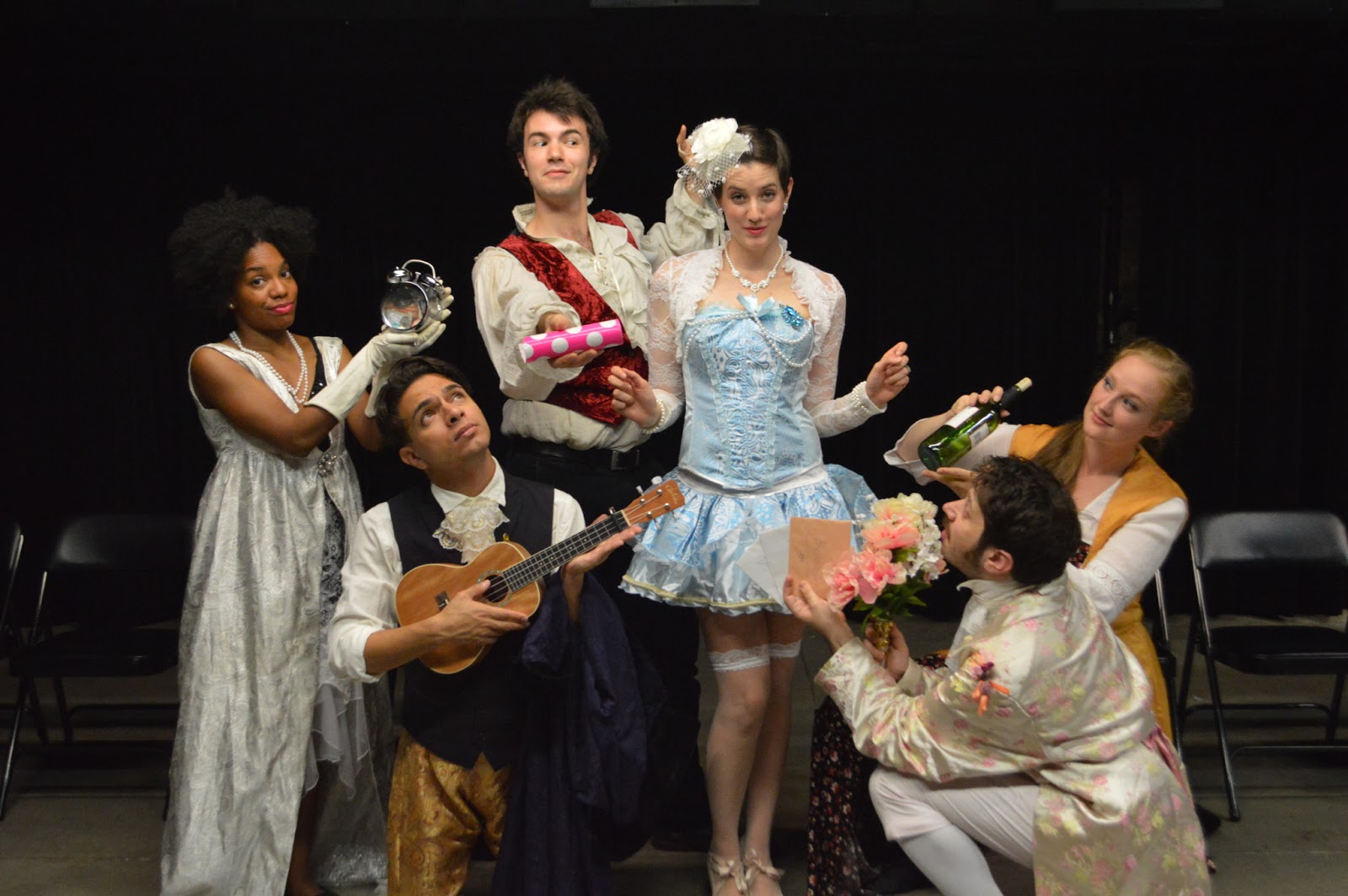
Regina Renee Russell, Chris Rivera, Justy Kosek, Amanda Roberts, Joe Raik,
and Bridget Randolph. Photo by Duncan Pflaster.


10/06/18: Uncle Romeo Vanya Juliet
What: Bedlam's mash-up of Chekhov's Uncle Vanya and Shakespeare's Romeo and Juliet.
And? This was not for me, unfortunately. It seemed oddly tame for Bedlam, and the connection between the R&J moments and the more dominant UV moments were not clear. Some good performances, especially from Bedlam regulars Susannah Millonzi and Edmund Lewis, and some interesting choices, but it felt like a lot of missed opportunities.

Randolf Curtis Rand, Zuzanna Szadkowski, Eric Tucker, and Susannah
Millonzi. Photo by Ashley Garrett.


10/07/18: Then She Fell
a repeat visit with friends (2013 review here)

Margin Notes: The Other, Other Woman

Laura Iris Hill as Mother Abbess. Photo by Duncan Pflaster.

Seen on: Thursday, 10/04/18.
My grade: B+

Plot and Background
A developmental reading by Turn to Flesh Productions of Emily C. A. Snyder's new verse play about polyamory and love-crossed souls in a small town in 18th century France.

Disclosure, and
What I Knew Beforehand
I've seen several of my friend Emily's verse plays at this point, so knew we'd be in capable hands, but I had avoided a plot synopsis so I could go in cold. (Continuing disclosure: Not only am I friends with auteur Snyder, I'm also friends with several of the cast members)

Thoughts:

Play: As this was a developmental reading (albeit an extremely polished one) and therefore a work in progress, I thought I would break down my feedback into what worked for me, and what I think could use more work or examination.

What works: Snyder's sparkling wit balanced with sillier humors--she's so clearly happily in her wheelhouse in this medium, and it's a pleasure to witness. The scenes flow swiftly and easily around each other, and the staging is poetic and clear. The polish and clarity of every moment belie all assurances that this is merely a workshop or reading. An able use of the ensemble as storytellers, witnesses, symbols, and people dealing with trying times. An abundance of female roles, of all stripes. When the rhyming couplets break apart into simple and honest speech, the audience takes a collective breath and holds it. The ache of love unexpressed and inexpressible.

What could use some examination: The occasional comic nods to the constraints of rhyming couplets--say, forcing a word into mispronunciation in order to make the rhyme perfect--would land more strongly if there weren't a number of slant rhymes elsewhere. Although the first act seems to champion polyamory, I was a bit disappointed to see that the second act paired nearly everyone off (except the queer characters), rejecting polyamory as an unsustainable option (indeed, Madame Evolette is soundly chastised by her husband Monsieur Beaudemonde for honoring their marriage contract so faithfully by indulging in countless sexual encounters but giving her heart to no one else). I felt uncomfortable watching what seemed like callous treatment of an emotionally unstable woman (played, in the first half, for laughs) and her abusive behavior toward her husband, and even more uncomfortable when that couple makes some fairly ugly choices which they know will make neither of them happy (choices which honestly seemed made in order to achieve a specific end in the plot, rather than following the characters on a journey of growth and change). I was disappointed that, with so many strong, varied, and interesting women portrayed in the piece, their lives all still seem entirely governed by the choices of the two male foils in the narrative, Beaudemonde and Valentine.

There's beautiful potential in this piece, piercing heartache and hilarity both.

Monday, October 1, 2018

Weekly Margin 2018, W39: The Waverly Gallery

9/27/18: The Waverly Gallery
What: Kenneth Lonergan's memory play about Gladys, a woman slowly succumbing to Alzheimer's, who runs a small obscure gallery on Waverly Place, and how her family copes.
And? I was really really bored. Sorry guys.